Vienna to Budapest by Train
Between the Two Danube Capitals
Vienna to Budapest is one of central Europe's great short international journeys: around 2 hours 20 minutes on the fastest direct trains, east from the imperial capital across the plains of eastern Austria and the Hungarian lowland to the banks of the Danube in Budapest. Both cities were built on the same river, and the train links them many times a day - fast, comfortable and border-free - carrying you from one grand Habsburg capital to another in little more than a long lunch.
It is a practical, destination-focused run rather than a scenic epic. The line crosses open, level country - the Leitha plain of Lower Austria, then the wide Kisalfold in Hungary - so the pleasure is less in the window than in the ease of it and in what waits at each end. The Danube is the thread: it flows through both capitals, and although the railway strikes across the plain rather than following the water, the journey ends with the great arrival into Budapest, one of Europe's most beautiful river cities. This guide covers the whole trip - which station your train uses at each end, ÖBB Railjet versus RegioJet, seats, passes, luggage, bikes and access, and how to reach the heart of Budapest.
Check your Budapest station before you travel: The two operators arrive at different stations. ÖBB and MÁV Railjet trains use Budapest Keleti; RegioJet trains use Budapest Déli. Both are central and both are on the metro, but they are not the same place - look at the station printed on your ticket.
Ready to book Vienna to Budapest?
Two operators run this line, both direct from Wien Hauptbahnhof. ÖBB and MÁV Railjet run roughly hourly to Budapest Keleti with Economy, First and Business classes and optional reservations. RegioJet adds several daily trains to Budapest Déli, with tiered classes, included refreshments and compulsory seat reservations. Interrail is accepted on both - reservation-free on Railjet, with a compulsory paid seat reservation on RegioJet. Book ahead for the best fares, and check which Budapest station is on your ticket.
Railero may earn a small commission if you book via the link above, at no extra cost to you.
Leaving Wien Hauptbahnhof
Wien Hauptbahnhof, Austria · 48.185°N, 16.378°E
Both operators leave from Wien Hauptbahnhof, Vienna's main long-distance station south of the centre, opened in 2015 and one of the best-connected hubs in central Europe - U-Bahn line U1, many trams and the S-Bahn all serve it, so it is quick to reach from anywhere in the city. A few ÖBB trains also call at Wien Meidling a little further out, so glance at your ticket, but the great majority start at the Hauptbahnhof. Boarding is relaxed: there is no airport-style check-in, so arrive 15 to 20 minutes ahead, watch the boards for your platform, and find your coach.
The one thing to settle before you go is your Budapest arrival station, because the two operators differ. ÖBB and MÁV Railjet trains run to Budapest Keleti, the grand eastern terminus; RegioJet trains run to Budapest Déli, on the Buda side near the Castle district. Both are central and both are on the metro, so neither is a problem once you know which you are heading for - just check the station printed on your ticket so you can plan the last step into the city.
Vienna–Budapest - Journey Facts
- RouteWien Hauptbahnhof → Budapest, across the plains between the two Danube capitals
- OperatorsÖBB/MÁV Railjet (to Keleti) and RegioJet (to Déli)
- Journey timeAround 2h 20m on the fastest trains; roughly 2h 20m to 2h 40m by service
- DistanceAbout 250 km east across Austria and Hungary
- FrequencyRoughly hourly Railjet plus several RegioJet daily - timetable-dependent
- ReservationsOptional on Railjet; compulsory on RegioJet
Across Eastern Austria
The Leitha plain, Lower Austria · 48.030°N, 16.780°E
Out of Vienna the train heads east into a landscape that is flat and open from the start - the Leitha plain, the farmland and low horizons of easternmost Lower Austria and the Burgenland edge. This is the corridor that has linked Vienna and the Hungarian lands for centuries, and it is easy, quick travelling: wide fields, the occasional village and wind farm, and the Little Carpathians a faint line away to the north-east. Within about half an hour the line is already near the frontier.
The Danube itself lies away to the north here - the river swings east out of Vienna on its own course toward Bratislava - so the railway takes the direct overland route across the plain rather than following the water. It is worth setting expectations honestly: this is not a river-gorge ride but a fast, comfortable dash across open country, the anticipation building toward the border and the Hungarian plain beyond.
This has been the road between Vienna and the Hungarian plain since the age of the Habsburgs - now covered in comfort before your coffee is cold.
Crossing into Hungary
Hegyeshalom and the Kisalfold · 47.916°N, 17.162°E
The border comes at Hegyeshalom, the historic frontier station where the Austrian network meets the Hungarian. There is no drama to it now: Austria and Hungary are both in the Schengen area, so there is normally no passport control and the train barely slows - the clearest sign you have crossed is the switch in station signs and the language of the announcements. Occasional police checks do happen on this corridor under temporary border measures, so carry your passport or ID card and keep it reachable.
Beyond the border the train runs out onto the Kisalfold, the Little Hungarian Plain - a broad, fertile lowland of maize and sunflower fields, one of the great agricultural basins of central Europe. It is level, open country, and the line runs fast and straight across it. The sense is of having arrived somewhere new: the roofs, the churches and the light all read as Hungary now, and Budapest is drawing closer with every few minutes.
Győr and the Run to Budapest
Győr · 47.688°N, 17.630°E
The main stop on the Hungarian side is Győr, roughly halfway across the country - a handsome baroque city at the meeting of three rivers, and an easy place to break the journey if you have time. Almost every fast train pauses here briefly before pressing on. Győr is a working industrial and university city with a beautifully preserved old town, and from its station there are connections south toward Lake Balaton and the Hungarian interior.
East of Győr the line runs on across the plain, threading the low Transdanubian hills around Tatabanya - the one place the country rises and folds a little - before descending toward the capital. The approach into Budapest is the moment the whole journey has been pointing at: the train reaches Budapest-Kelenfold on the Buda side, then crosses the Danube, and the city opens out around you as you draw into the terminus.
Worth Knowing
Arriving at Budapest Keleti
Budapest Keleti, Hungary · 47.500°N, 19.084°E
Budapest Keleti - literally the "eastern" station - is the grand terminus most Railjet trains arrive at, a monumental 1884 building whose great arched trainshed and statue-topped facade are a landmark in their own right. It sits on the Pest side, a little east of the centre, and it is the hub of Hungary's international network. It is a busy, fully-equipped station, and while it has lifts and step-free routes to the platforms, it is a historic terminus rather than a sleek new build, so allow a little time to find your way and consider booking assistance in advance if you need it.
Getting into the centre is quick and easy. Keleti is a transfer station on metro lines M2 (red) and M4 (green): the M2 runs two stops west to Deák Ferenc tér, Budapest's main interchange in the heart of Pest, in about five minutes, and on to Kossuth Lajos tér right beside the Parliament. The centre is also a walk of about 15 to 20 minutes. From the middle of the city the great sights line up along the river - the Parliament and the Danube promenade on the Pest bank, the Chain Bridge across to Buda, and above it Buda Castle and the Fisherman's Bastion on the hill, reached by the M2 to the Buda side and a short climb or the funicular. RegioJet's Budapest Déli is likewise on the M2, on the Buda side.
From Budapest Keleti
ÖBB Railjet or RegioJet - How to Choose
Two operators, two Budapest stations
This corridor is one of the few in the region with genuine competition, and both options are good. ÖBB/MÁV Railjet is the frequent flagship: modern, roughly hourly, with Economy, First and Business classes, a dining car, wifi and quiet zones, running from Wien Hauptbahnhof to Budapest Keleti. RegioJet is the independent challenger - a private operator with fewer daily trains, running to Budapest Déli, known for its tiered classes from low-cost to Business, its included refreshments and at-seat service, and its friendly, distinctive style. Journey times are broadly similar, so the choice is less about speed than about frequency, your arrival station and the onboard experience you want.
Railjet may suit you if you want the most frequent departures, arrival at Keleti, a reservation that is optional rather than required, or an onward ÖBB connection. RegioJet may suit you if its timetable lands well, you like its cabins and included refreshments, or Budapest Déli is handier for where you are staying on the Buda side. For pass holders, both accept Interrail - but note the reservation difference: none needed on Railjet, compulsory (and paid) on RegioJet. Neither is universally better; pick on your timetable, your station and your taste.
ÖBB/MÁV Railjet vs RegioJet
- Budapest stationRailjet: Keleti · RegioJet: Déli - check your ticket
- FrequencyRailjet: roughly hourly · RegioJet: several daily
- ClassesRailjet: Economy / First / Business · RegioJet: low-cost to Business tiers
- ReservationsRailjet: optional · RegioJet: compulsory, assigned seat
- OnboardRailjet: dining car, quiet zones · RegioJet: included refreshments, at-seat service
- Rail passesInterrail on both · Railjet reservation-free · RegioJet needs a paid reservation
Is the Journey Scenic?
An honest look at the window
It is worth being straight about this: Vienna to Budapest is a pleasant journey rather than a spectacular one. The line runs fast and almost entirely level across open agricultural country - the Leitha plain in Austria and the wide Kisalfold in Hungary - so the window offers fields, villages, church towers and big skies rather than mountains or gorges. If you are hoping for a Danube-gorge ride, that is a different line: the famous Wachau valley is on the route west from Vienna toward Linz, not on the way to Budapest.
What this route does have is a superb arrival. After the plain, the train reaches the Buda side at Kelenfold and crosses the Danube into the city, and Budapest - one of the great river capitals of Europe - unfolds around you. There is no strongly preferred side for views along the way; the countryside is much the same to left and right, and the highlight is the cityscape at the end rather than any single stretch of line. Travel by daylight if you can, less for the fields than to arrive with the city and the river in front of you.
Onward Travel from Budapest
One of central Europe's great rail hubs
Budapest is one of the most important rail hubs in central Europe - the meeting point of routes between the west and the Balkans, and the centre of Hungary's own network. Its three main stations (Keleti, Nyugati and Déli) send trains out across the country and the continent, so arriving here opens up a great deal. Some connections are fast and frequent domestic runs; others are longer international journeys. It is worth checking which Budapest station your onward train leaves from, as it is not always the one you arrived at.
Onward from Budapest
- BratislavaFrequent EuroCity, around 2h 15m
- PragueDirect EC and RegioJet, roughly 6h 30m to 7h
- ZagrebDirect trains south into Croatia, around 5 to 6h
- BucharestLong-distance and overnight trains, roughly 15 to 16h
- Lake BalatonFrequent domestic trains to Siofok and the lake, around 1h 30m to 2h
- DebrecenFast domestic trains east, around 2h 15m to 3h
- EgerRegional trains north, around 2h (sometimes with a change)
- SzegedFast domestic trains south, around 2h 15m
Reach Budapest and central Europe opens up: Bratislava and Prague to the north, Zagreb and Bucharest to the south and east, and all of Hungary between.
Reservations, Passes, Luggage, Bikes and Access
The practical rules for the Vienna–Budapest line
Reservations depend on the operator. On ÖBB/MÁV Railjet a seat reservation is optional - never required to travel, but worth adding on busy summer weekends and holidays. On RegioJet a reservation is compulsory, and every ticket comes with an assigned seat. For pass holders, Interrail is accepted on both: no reservation needed on Railjet, while RegioJet requires a compulsory paid seat reservation even with a pass, bookable online, at the station or from the onboard crew. For the wider picture, see the rail passes and seat reservations guides linked below.
Luggage is easy on both: there is no strict weight limit for normal bags - you carry them aboard yourself and use the overhead shelves and the larger racks near the doors - so broadly anything you can carry or wheel is fine. Board a few minutes early on busy departures to find space and keep valuables with you. Bikes need more planning and the rules are similar on both operators: a full bicycle needs a bike ticket and a reservation for one of the limited spaces, best arranged in advance, while a folded or bagged bike travels as luggage. Always check the current bike policy before turning up with one.
On accessibility, Wien Hauptbahnhof is a modern, fully step-free station with lifts throughout. Budapest Keleti has lifts and step-free routes to the platforms but is a historic terminus, so it is less uniformly modern - do not assume every train and platform is equally straightforward. For guaranteed boarding help, ÖBB's mobility service and MÁV's station assistance should be booked in advance, and RegioJet can arrange assistance too. Accessibility depends on the specific train, platform and station, so arranging help ahead is the reliable approach.
Quick Tips
Check your Budapest station: Railjet arrives at Keleti, RegioJet at Déli - confirm which before you travel so you can plan the last step.
Passes work on both: Interrail is valid on Railjet (no reservation) and RegioJet (compulsory paid reservation).
Book access ahead: for guaranteed boarding assistance, arrange ÖBB/MÁV (or RegioJet) help in advance, especially at Keleti.
Hotels in Budapest
Budapest rewards staying in central Pest near the Danube - close to the Parliament, the river promenade and the Chain Bridge across to Buda, an easy metro ride from Keleti along the M2.
Budapest - on the Danube by the Chain Bridge
The restored Art Nouveau Gresham Palace on the Pest embankment, directly facing the Chain Bridge and Buda Castle across the river - Budapest's most celebrated address, in the heart of everything.
Budapest - central Pest, by Váci utca
A stylish, well-run boutique hotel in the middle of Pest near Váci utca and the Great Market Hall, with a rooftop bar - walkable to the river and a few metro minutes from Keleti.
Budapest - central Pest, on the M2
A dependable, fairly priced classic hotel with a grand old cafe, at the Astoria junction in central Pest - directly on the M2 metro two stops from Keleti and walkable to the river and old town.
Hotel links open Booking.com. Railero may earn a commission on bookings at no extra cost to you.
Frequently Asked Questions
- How long is the train from Vienna to Budapest?
- The fastest direct Railjet trains take around 2 hours 20 minutes; most services run roughly 2h 20m to 2h 40m depending on stops. It is about 250 km east across the plains between the two Danube capitals. Exact times vary by operator and service, so check the current schedule when you book.
- Are there direct trains from Vienna to Budapest?
- Yes, many. ÖBB and MÁV run joint Railjet and EuroCity trains direct roughly every hour through the day, and the private operator RegioJet adds several more direct departures. No change of train is needed in either direction.
- Which station do Vienna to Budapest trains leave from, and where do they arrive?
- Departures are from Wien Hauptbahnhof, Vienna's main station (some ÖBB trains also call at Wien Meidling). The arrival station depends on the operator: ÖBB and MÁV Railjet trains arrive at Budapest Keleti, the grand eastern terminus, while RegioJet trains use Budapest Déli on the Buda side. Both are central and both are served by the metro, but they are different stations, so check which one is on your ticket.
- Is it ÖBB Railjet or RegioJet - and which is better?
- Neither is universally better. ÖBB/MÁV Railjet is the frequent flagship service, roughly hourly to Budapest Keleti, with Economy, First and Business classes, a dining car and optional reservations. RegioJet is a private operator with fewer daily trains to Budapest Déli, known for its tiered classes (from low-cost to Business), included refreshments and at-seat service, and compulsory seat reservations. Choose on your timetable, your arrival station and the onboard experience you prefer.
- Do I need a seat reservation?
- It depends on the operator. On ÖBB/MÁV Railjet a seat reservation is optional - not required to travel, but worth adding on busy summer weekends and holidays. On RegioJet a reservation is compulsory: every ticket comes with a specific assigned seat. If you are travelling on a rail pass, you can still board either, but RegioJet needs a paid seat reservation first.
- Can I use an Interrail pass?
- Yes - Interrail is accepted on both ÖBB/MÁV Railjet and RegioJet on this route. On Railjet no reservation is required (though one is available and advisable at busy times). On RegioJet a compulsory paid seat reservation is needed even with a pass, bookable online, at the station or from the onboard crew. It is a simple, pass-friendly route either way.
- How much luggage can I take?
- There is no strict weight limit for normal luggage on either operator - you carry your bags aboard yourself and use the overhead shelves and the larger racks near the doors. Broadly, anything you can carry or wheel is fine. Board a few minutes early on busy departures to find space, and keep valuables with you.
- Can I take a bicycle?
- Yes, but bike spaces are limited and need booking. On ÖBB/MÁV Railjet a full bicycle needs a bike ticket and a reservation for one of the limited spaces, best arranged in advance at the station. RegioJet also carries bikes in limited spaces with a reservation. A folded or dismantled bicycle in a bag travels as luggage on both. Check the operator's current bike policy before you travel.
- Is the Vienna to Budapest train scenic?
- It is pleasant rather than dramatic. The line runs fast and mostly level across the open farmland of eastern Austria and the Kisalfold plain in Hungary, so it is easy, comfortable travelling rather than mountain scenery. The Danube links the two cities but the railway does not follow it closely; the visual highlight is the arrival, crossing into Budapest with the city and the river ahead. There is no strongly preferred side for views.
- How do I get from Budapest Keleti into the city centre?
- Easily. Budapest Keleti is a transfer station on metro lines M2 (red) and M4 (green). The M2 runs two stops west to Deák Ferenc tér, Budapest's main interchange in the heart of Pest, in about 5 minutes, and on to Kossuth Lajos tér for the Parliament. The city centre is also about a 15 to 20 minute walk. RegioJet's Budapest Déli is likewise on the M2, on the Buda side near the Castle district.
- Can I continue deeper into Hungary or beyond?
- Yes - Budapest is one of Central Europe's great rail hubs. Frequent domestic trains reach Lake Balaton, Győr, Debrecen, Eger and Szeged, while international services run to Bratislava, Prague, Zagreb, Bucharest and beyond. Many of these leave from Keleti or Nyugati stations, so check which Budapest station your onward train uses.
Continue Your Journey
Routes that pair naturally with this one — for building your European itinerary.
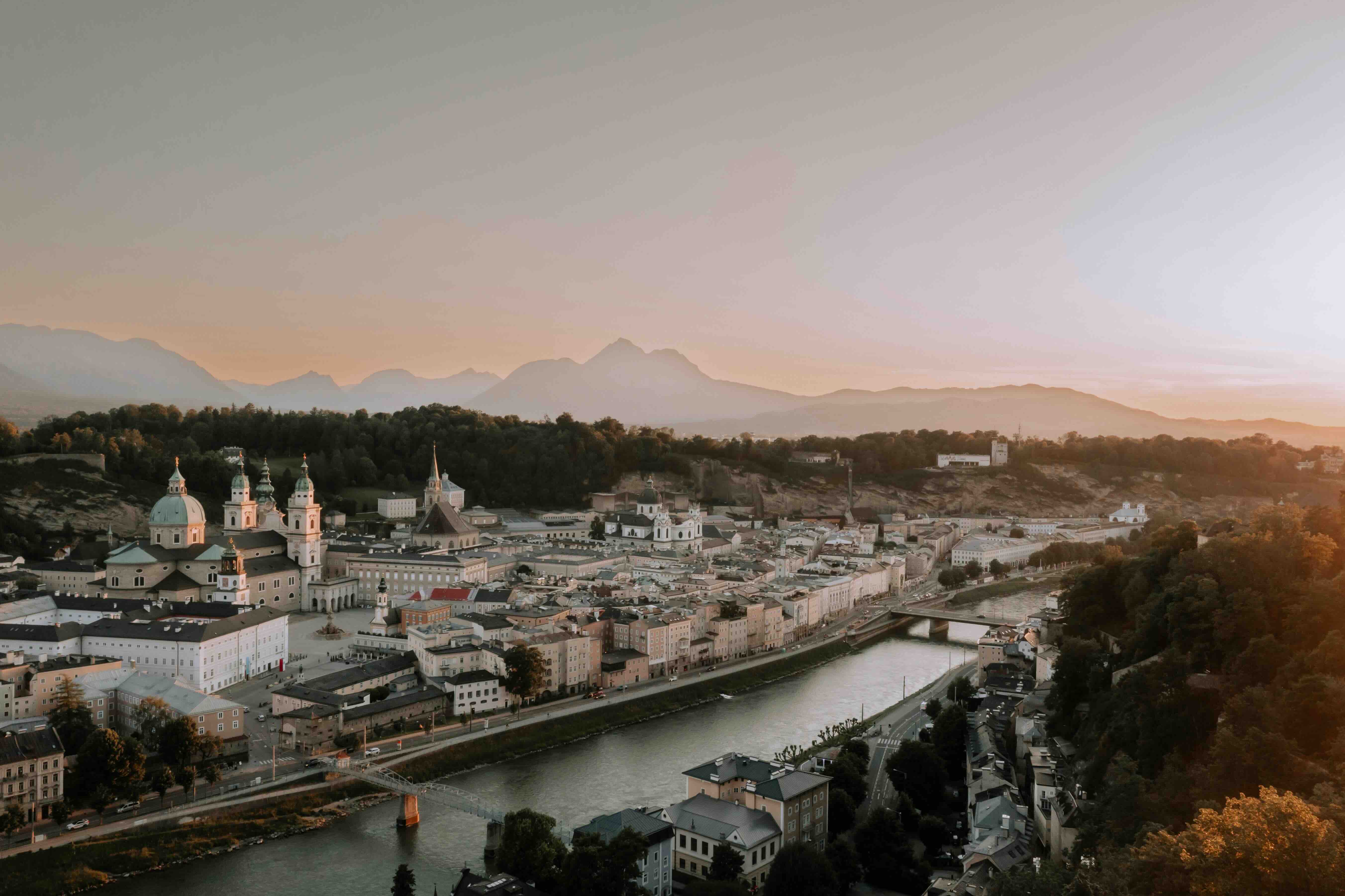
Vienna → Salzburg
~2h 25m · ÖBB Railjet / WESTbahn
The other way from Vienna: west to Salzburg
View RouteInterrail and the Swiss Travel Pass — when a pass beats point-to-point tickets and when it does not.
When reservation is mandatory, which side of the train has the views, and how to choose your class.
Vienna to Budapest is the easy, essential central European journey: a little over two hours east from one Danube capital to another, on frequent direct trains that rarely need reserving. Choose ÖBB/MÁV Railjet or RegioJet on your timetable and your arrival station, remember that a rail pass works on both, and treat Budapest as a beginning - Bratislava, Prague, the Balkans and all of Hungary lead onward from where you arrive.
Back to all routes