
Marseille to Nice by Train
The Cote d'Azur Coastal Railway
Marseille to Nice is France's great Mediterranean rail journey: around two and a half hours east along the coast, from the terminus above the old port of Marseille to the palm-lined seafront of Nice. For much of the way the line runs beside the sea itself, past the naval harbour of Toulon, the red cliffs of the Esterel, and the resort coast of Cannes and Antibes, before curving into Nice-Ville a short walk from the Promenade des Anglais. It is a working railway that happens to be one of the most beautiful coastal lines in Europe.
There is a particular pleasure to this route: no high-speed line runs east of Marseille, so the trains take the old coastal track at a human pace, and the Mediterranean does the work. The sea appears and disappears - open and dazzling along one stretch, hidden behind a tunnel or an inland loop the next - and the Riviera unrolls town by town outside the window. Nice at the end is not so much a destination as a doorway: from its station, trains fan out along the coast to Monaco, Menton and across the border into Italy. This guide covers the whole run - TER or TGV, seats, passes, which side to sit for the views, and what to do when you arrive.
Why the train wins here: This is a journey to take slowly and by daylight. A plane between the two would mean two airports and their transfers for a hop of barely 200 km; the train runs city centre to city centre beside the sea, and the view from the window is the whole point.
Ready to book Marseille to Nice?
Two kinds of train run this coast, both direct. TER is the frequent regional service - no reservation, full flexibility, turn up and go - and it calls at more of the seaside towns. TGV INOUI is a little faster with fewer stops, all-reserved, and best enjoyed from the upper deck of a double-deck set. Interrail works on both: free of reservation on TER, with a compulsory paid reservation on TGV INOUI. Book TGV ahead for the fare and the seat; for the TER, simply buy and board.
Railero may earn a small commission if you book via the link above, at no extra cost to you.
Leaving Marseille Saint-Charles
Marseille Saint-Charles, France · 43.303°N, 5.381°E
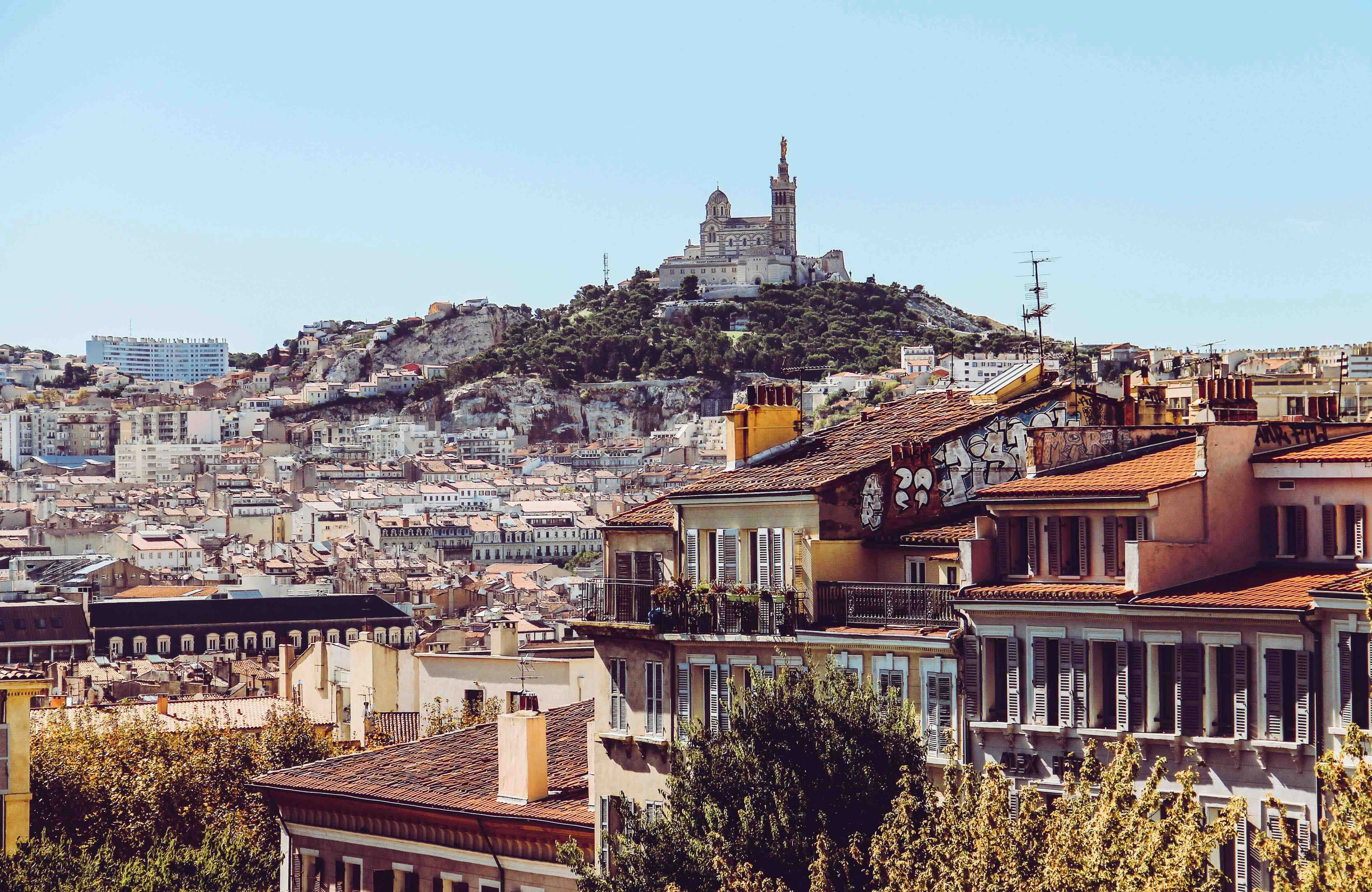
The journey east begins at Marseille Saint-Charles, the terminus set on a rise above the city, reached from the streets below by the monumental staircase at its front. It is a busy, characterful station and the hub of the French Mediterranean - metro lines 1 and 2 run beneath it, and trains leave from here for the whole of the south. Boarding is relaxed: there is no airport-style check-in, so arrive fifteen to twenty minutes ahead, watch the boards for your platform, and find your coach.
One thing to settle before you go is which train you are taking, because it shapes the trip more than usual. Both TER and TGV INOUI leave Saint-Charles for Nice and both run the same coastal line, but the TER is the frequent, reservation-free regional service while the TGV is faster-stopping and all-reserved. Either way, try to travel in daylight and, if you can, take a seat on the right-hand side facing forward - that is the seaward side for most of the run east.
Marseille–Nice - Journey Facts
- RouteMarseille Saint-Charles → Nice-Ville, along the Mediterranean coast
- OperatorsTER (regional, reservation-free) and TGV INOUI (faster, all-reserved)
- Journey timeAround 2h 30m to just under 3h - TGV only a little faster than TER
- DistanceAbout 225 km along the coast; no high-speed line east of Marseille
- FrequencyFrequent trains through the day - timetable-dependent
- Best viewsThe seaward, right-hand side travelling east - but not the whole way
Along the Coast to Toulon
Toulon · 43.129°N, 5.930°E
Out of Marseille the line climbs away from the city and runs south-east toward the coast, and within the first stretch it gives some of the best sea views of the whole journey - the calanques country around Cassis and La Ciotat, where white limestone drops into a very blue sea and small harbours cluster in the inlets. This early section, before Toulon, is one of the two great scenic passages, so it is worth being settled in a seaward seat from the start rather than still finding your place.
Toulon, roughly the first hour out of Marseille, is the great naval port of France, its harbour ringed by wooded hills and usually full of grey warships - a working city rather than a resort, and all the more interesting for it. The station sits just back from the waterfront. Beyond Toulon the railway leaves the coast for a while, turning inland through the foothills of the Massif des Maures, a green, quieter stretch of cork oak and vineyard that reaches its furthest point from the sea around Les Arcs-Draguignan.
The Mediterranean sets the rhythm of this line: it comes and goes, and the trick is to be on the right side when it returns.
The Esterel Corniche: the Great Sea Views
Saint-Raphael-Valescure · 43.425°N, 6.768°E
At Saint-Raphael the line comes back to the sea, and the finest scenery of the route begins. From here to Cannes the railway runs along the Corniche de l'Esterel, threaded onto a coast of deep red porphyry cliffs falling straight into turquoise water, past coves and marinas and the little resorts of Boulouris, Le Trayas and Antheor. This is the passage the route is famous for: much of it is right at the water's edge, the track carried on ledges and low viaducts between short tunnels through the headlands, with the sea filling the windows on the seaward side.
It is worth being honest about it too. The Esterel is a mountain massif meeting the sea, so the line is a sequence of tunnels, cuttings and open stretches rather than an unbroken balcony over the water - the views come in bursts, dramatic when they open out and gone again a moment later. That rhythm is part of the pleasure. On a bright day, with the red rock, the pines and the blue of the Mediterranean, this half-hour is as good as coastal railways get in Europe.
Which Side for the Views
Travelling east the Mediterranean is on the right, so a right-side seat facing the direction of travel gives the sea views. The two standout passages are Marseille to Toulon (the calanques coast around Cassis and La Ciotat) and Saint-Raphael to Cannes (the red cliffs of the Esterel corniche). Between Toulon and Les Arcs the line runs inland through the Maures, so the sea drops out of view there. On a double-deck TGV the upper deck gives the best vantage of all; TER trains are single-deck but sit closer to the shore. Note that tunnels and cuttings interrupt the view throughout, so no single seat has the sea the whole way - it is a preference, not a guarantee.
Cannes and the Riviera Resorts
Cannes · 43.554°N, 7.020°E
Beyond the Esterel the line reaches Cannes, and the character of the coast changes again - from wild red cliffs to the groomed glamour of the Riviera proper. Cannes station is a short walk back from the Croisette, the palm-lined seafront of grand hotels and the festival hall, and it is one of the busiest stops on the line, with frequent trains in both directions. From here east the railway stays close to the sea, running through a near-continuous ribbon of resorts and marinas.
This eastern stretch is where the TER really comes into its own: the towns are close together and the regional trains stop at all of them, so it is easy to hop off for an afternoon and pick up a later train. Juan-les-Pins, Golfe-Juan and the approach to Antibes follow in quick succession, the sea rarely out of sight for long, and the mountains of the pre-Alps rising inland behind the coast.
Antibes and the Run into Nice
Antibes · 43.584°N, 7.123°E
Antibes is the last major stop before Nice - an old town behind honey-coloured ramparts, with one of the largest yacht harbours in the Mediterranean and the Cap d'Antibes reaching out to the south. The station is a few minutes' walk from the ramparts and the market, and it makes an easy day trip from Nice in its own right. From here the train runs the final stretch of coast, past Villeneuve-Loubet and Cagnes-sur-Mer, with the sea on one side and the racecourse and the hills on the other.
The approach to Nice curves along the Baie des Anges, the great sweep of pebble beach that the Promenade des Anglais follows, and then the train slows into Nice-Ville. After the coast you have just travelled, the arrival feels earned: you step off in the middle of the Riviera's capital, a short walk from the sea.
Worth Knowing
Arriving at Nice-Ville
Nice-Ville (Gare Thiers), France · 43.705°N, 7.262°E
Nice-Ville, sometimes signed Nice Thiers after the street it stands on, is the city's main station and the hub of the Riviera network. It is a busy, well-equipped station - staffed, with lifts to the platforms, shops and left-luggage - set a little north of the seafront rather than on it. The centre and the sea are close and easy to reach, so it is worth knowing the options before you set off into the city.
On foot, it is about a 15 to 20 minute walk south down Avenue Jean Medecin - the city's main shopping street - to Place Massena and the Promenade des Anglais on the Baie des Anges, roughly 1.5 km. Tram line 1 runs from outside the station down to Place Massena and the edge of the old town (Vieux Nice), and connects to tram line 2, which runs east-west along the coast toward the port (Port Lympia) and out to the airport. Between them the two tram lines reach most of what a visitor wants, and Nice makes an excellent, well-connected base for exploring the whole Riviera.
From Nice-Ville
TER or TGV INOUI - How to Choose
Two trains on the same coastal line
The usual TGV-versus-regional question works differently here, because there is no high-speed line east of Marseille - both trains run the same classic coastal track at similar speeds. The TGV INOUI is only a little faster, purely because it stops less; it is all-reserved, so every ticket is tied to a specific train and seat, and on a double-deck set the upper deck gives the best views. The TER is the frequent regional workhorse: no reservation, full flexibility, and stops at far more of the coastal towns, which makes it ideal for hopping along the Riviera.
So the choice is less about speed than about how you want to travel. TGV INOUI suits you if you want a guaranteed seat on a specific direct train and are happy to book ahead. TER suits you if you value flexibility, want to stop off along the way, are travelling on a rail pass, or simply want to turn up and catch the next train. For many people on this route the reservation-free TER is the more relaxed and characterful choice - but neither is better in the abstract, and both give you the same coast.
TER vs TGV INOUI
- SpeedSimilar - same classic line; TGV a little faster by stopping less
- ReservationsTER: none needed · TGV INOUI: compulsory, all-reserved
- FrequencyTER: frequent all day · TGV: several direct services daily
- FlexibilityTER: fully flexible, hop on and off · TGV: tied to one train
- ViewsTER: single-deck, close to the shore · TGV: best from the upper deck
- Rail passesBoth accepted · TER reservation-free · TGV needs a paid reservation
Onward Travel from Nice
One of Europe's great rail gateways
Nice is one of the major rail gateways of the Mediterranean, and much of the pleasure of arriving is how easily you can carry on. East of the city the coastal line continues along the Riviera to Monaco, Menton and across the border into Italy at Ventimiglia, where Italian trains take over for the run toward Genoa and Milan. West lie Cannes, Antibes and, on a branch inland, the perfume town of Grasse. Most of these are frequent, reservation-free TER hops - the same easy, turn-up-and-go travel as the main route.
Onward from Nice
- Monaco (Monte-Carlo)Frequent TER east along the coast, around 20 to 25 min
- MentonTER near the Italian border, about 35 min
- Ventimiglia (Italy)TER across the border, roughly 45 min to an hour
- GenoaItalian trains from Ventimiglia, around 3 hours with a change
- MilanVia Ventimiglia or Genoa with a change - a longer day
- Cannes & AntibesFrequent TER west - Antibes about 25 min, Cannes about 30 min
- GrasseTER on the inland branch via Cannes, around 1h 10m
- EzeEze-sur-Mer by coastal TER; the hilltop village needs a bus up from the shore
A word on Eze, which is often misjudged: the famous hilltop village of Eze sits high above the coast, while the railway serves Eze-sur-Mer down at sea level, so reaching the village means a steep bus (or a stiff walk) up from the station. For Monaco, Menton and Ventimiglia, by contrast, the stations are right in the towns, and the coastal TER makes an easy string of day trips from a Nice base.
Reach Nice and the Riviera is open: Monaco, Menton and Italy one way, Cannes and Antibes the other, all a short hop down the coast.
Reservations, Passes, Luggage, Bikes and Access
The practical rules for the coastal line
Reservations depend on the train. TGV INOUI is all-reserved, so every ticket is for a specific train with an assigned seat and there is no boarding an earlier or later one on the same ticket - book ahead. TER services do not use reservations at all: buy a ticket and board any train. For pass holders, Interrail is accepted on both, but the practicalities differ - TER is reservation-free and the simplest possible pass travel, while TGV INOUI needs a compulsory paid pass-holder reservation from a limited quota, so book it early. For the wider picture, see the rail passes and seat reservations guides linked below.
Luggage is straightforward on both: there is no strict weight limit, you carry your bags aboard and use the racks, with TGV INOUI offering larger dedicated luggage areas and TER the usual overhead and end-of-carriage space - board a few minutes early on busy departures to find room. Bikes need more thought and the rules differ: many TER services in the region carry non-dismantled bicycles in marked spaces, often without charge or reservation but limited in number, while TGV INOUI carries a full bike only in a reserved bike space on the trains that offer one. A folded or bagged bike travels as luggage on both, so check the current policy before turning up with a bicycle.
On accessibility, both Marseille Saint-Charles and Nice-Ville are large, staffed stations with step-free access and lifts to the platforms. SNCF's Assist'enGare service provides boarding and platform assistance and is best booked in advance - do not assume every train and platform is equally straightforward, as access can depend on the specific service and station. Arranging assistance ahead is the reliable approach for step-free travel across this route.
Quick Tips
Travel by daylight: the sea is the whole point - take a daytime train and a seaward seat rather than rushing the fastest one.
Sit on the right: travelling east, the right-hand side facing forward is the seaward side - and the upper deck of a TGV is best.
For passes and stops, take the TER: reservation-free and frequent, it lets you hop off along the coast and catch the next train.
Hotels in Nice
Nice rewards staying between the station and the sea - close to Avenue Jean Medecin, Place Massena and the old town, with the Promenade des Anglais and the tram network a few minutes away.
Nice - on the Promenade des Anglais
The legendary Belle Epoque palace on the seafront, with its pink dome and grand salons - Nice's most famous address, right on the Promenade des Anglais above the Baie des Anges.
Nice - by the old town and Castle Hill
A quiet, well-run hotel tucked against Castle Hill at the edge of Vieux Nice, with sea views and a garden pool - close to the old town, the port and the eastern end of the Promenade.
Nice - between the station and the sea
A dependable, fairly priced classic hotel with a large garden, set between Nice-Ville station and Place Massena - a short walk to the trains, the trams and the seafront.
Hotel links open Booking.com. Railero may earn a commission on bookings at no extra cost to you.
Frequently Asked Questions
- How long is the train from Marseille to Nice?
- Direct trains typically take around 2 hours 30 minutes to just under 3 hours. Because there is no high-speed line east of Marseille, TGV and TER run at similar speeds along the same coastal track; the TGV is only a little faster because it makes fewer stops. It is about 225 km along the coast, and exact times vary by service, so check the current schedule when you book.
- Is the Marseille to Nice train scenic?
- Yes - it is one of the most scenic coastal railways in Europe, running much of the way beside the Mediterranean. The finest stretches are along the sea before Toulon and between Saint-Raphael and Nice, where the line threads the red cliffs of the Esterel past coves and marinas. It is not an unbroken sea view, though: the route is mountainous, with tunnels and cuttings and an inland stretch through the Maures around Les Arcs, so the views come and go.
- Should I take the TER or the TGV from Marseille to Nice?
- Both use the same coastal line, so it is less about speed than about how you travel. TER is the frequent, turn-up-and-go regional service with no reservation needed and full flexibility, and it stops at more of the coastal towns. TGV INOUI is a little faster with fewer stops, has assigned seats you must reserve, and on a double-deck set the upper deck gives the best views. For pass holders and spontaneous trips the TER is usually the easier choice; the TGV suits those who want a booked seat on a specific direct train.
- Do I need a seat reservation?
- It depends on the train. TGV INOUI is all-reserved, so every ticket is tied to a specific train with an assigned seat and you must book ahead. TER services do not use reservations at all - you simply board with a valid ticket and sit where you like, which is part of their appeal on this scenic route.
- Can I use an Interrail pass?
- Yes. On TER trains a pass is straightforward: no reservation is required, so you just activate a travel day and board. On TGV INOUI a pass is accepted but needs a compulsory paid pass-holder reservation from a limited quota, so book it early. For a flexible pass trip along the coast, the reservation-free TER is usually the simplest option.
- Which side of the train has the best views?
- Travelling east from Marseille to Nice, the sea is on the right-hand side, so a right-side seat facing the direction of travel gives the best sea views - especially between Marseille and Toulon and between Saint-Raphael and Cannes. On a double-deck TGV the upper deck is best of all. Bear in mind the line runs inland in places and through tunnels, so no single seat has the sea in view the whole way.
- Can I take luggage or a bicycle?
- Luggage is easy on both: there is no strict weight limit, and you carry your bags aboard and use the racks - TGV INOUI has larger luggage areas, while TER has overhead and end-of-carriage space. Bicycles differ by train: many TER services carry non-dismantled bikes in marked spaces, often free and without reservation but limited in number, while TGV INOUI needs a reserved bike space on the trains that offer one. A folded or bagged bike travels as luggage on both. Check the current policy before travelling with a bike.
- How do I get from Nice-Ville station to the Promenade des Anglais?
- It is close. Nice-Ville sits a little north of the seafront, and it is about a 15 to 20 minute walk south down Avenue Jean Medecin to Place Massena and on to the Promenade des Anglais, roughly 1.5 km. Tram line 1 runs from the station (Gare Thiers stop) down to Place Massena and the old town, and connects to tram line 2, which runs east-west along the coast toward the port and the airport.
- How early should I arrive at the station?
- For a domestic TGV or a TER there is no airport-style check-in, so 15 to 20 minutes is plenty to find your platform and board. Platform numbers are typically shown on the departure boards shortly before departure, so watch the boards rather than heading to a platform too early.
- Can I continue from Nice to Monaco or Italy?
- Easily - Nice is one of the great rail gateways of the Riviera. Frequent TER trains run east along the coast to Monaco in around 20 to 25 minutes, Menton in about 35 minutes, and across the border to Ventimiglia in Italy in roughly 45 minutes to an hour. From Ventimiglia, Italian trains continue toward Genoa and Milan. Cannes, Antibes and Grasse lie the other way, all reachable by frequent regional trains.
Continue Your Journey
Routes that pair naturally with this one — for building your European itinerary.
Marseille to Nice is the Mediterranean by rail: two and a half unhurried hours along the Cote d'Azur, past the calanques, the Esterel cliffs and the resort coast, to a station a short walk from the Promenade des Anglais. Take a daytime train and a seaward seat, choose the reservation-free TER if you want to stop and wander, and remember that Nice is a gateway - Monaco, Menton and Italy all lie a short hop further down the coast.