Nice to Milan by Train
The Riviera Crossing into Italy
Nice to Milan is the natural way from the French Riviera into northern Italy by rail: along the Mediterranean coast past Monaco and Menton to the border at Ventimiglia, then up the Italian Riviera through Genoa and inland to Milan. It is not a single fast train but a two-leg journey - a French regional train to the border, a change at Ventimiglia, and an Italian Intercity onward - and that is part of its character. Around five and a half hours all told, much of it beside the sea, it is a scenic crossing between two countries rather than a sprint.
The appeal is in the coast and the crossing. The first half hugs the Riviera, one of the most beautiful stretches of railway in Europe, slipping past the principality of Monaco and the lemon-terraced hills of Menton to the frontier. At Ventimiglia you step from a French train onto an Italian one, and the journey changes character - the Riviera dei Fiori, the great port of Genoa, and then the run inland across the Apennines to Milan, Italy's business capital and its principal rail hub. This guide is honest about the change, the two operators and the reservations, and shows you how to make the crossing simple.
The one thing to know: There is no direct train. You change at Ventimiglia, the first station across the Italian border, from the French TER to the Italian Intercity. It is an easy step-across change - just allow a comfortable connection there, particularly when heading into Italy, because the French train can run a little late and the Italian one has a reserved seat waiting. Around 30 to 45 minutes gives useful protection, but check your specific itinerary.
Ready to book Nice to Milan?
This is a two-leg journey with a change at Ventimiglia. The French SNCF TER from Nice to the border is second class only with no reservations - you just board. The Italian Trenitalia Intercity from Ventimiglia to Milan via Genoa is fully reserved, so book that leg ahead, especially in summer. You can buy a single through-ticket or the two legs separately; either way the change is the same. Interrail is accepted on both, with a compulsory paid reservation on the Italian Intercity.
Railero may earn a small commission if you book via the link above, at no extra cost to you.
Leaving Nice along the Riviera
Nice-Ville, France · 43.705°N, 7.262°E
The journey begins at Nice-Ville, the Riviera capital's main station a short walk or tram ride north of the seafront. This is where the French coastal line to the border begins, and the first leg is a French SNCF TER - a comfortable regional train, second class only, with no reservations, so you simply buy a ticket and board. Trains to Ventimiglia are frequent, running roughly every 20 to 30 minutes through the day, so there is no need to fix on a single departure for this stretch.
Pulling out of Nice, the train is quickly beside the Mediterranean, and the coast puts on a show from the start. Try to sit on the right-hand side facing forward - the seaward side heading east - and travel by daylight: this first half, along the French and then Italian Riviera, is the scenic heart of the journey.
Nice–Milan - Journey Facts
- RouteNice-Ville → Milano Centrale, via Ventimiglia and Genoa - with a change
- OperatorsSNCF TER (Nice-Ventimiglia) and Trenitalia Intercity (Ventimiglia-Milan)
- Journey timeAround 5h 30m with the change; often closer to 6h, connection-dependent
- The changeAt Ventimiglia, the border station - allow a comfortable connection (around 30 to 45 min)
- DistanceAbout 330 km along the coast and then inland to Milan
- ReservationsNone on the French TER; compulsory on the Italian Intercity
Monaco, Menton and the Run to the Border
Monaco-Monte-Carlo · 43.739°N, 7.419°E
The stretch from Nice to the border is short but lovely, the line threading the corniche coast where the mountains drop straight to the sea. It calls at Monaco-Monte-Carlo, whose station is buried in the rock beneath the principality, and at the little towns of the Riviera - Cap-d'Ail, Beaulieu, Eze-sur-Mer - before reaching Menton, the last town in France, famous for its lemons and its warm microclimate, with the pastel old town rising above the sea.
Beyond Menton the train runs the final few minutes to the frontier. There is no drama to the crossing: France and Italy are both in the Schengen area, so there are normally no passport controls, and the border passes almost unnoticed as the coast rolls on. Then the line reaches Ventimiglia, the first station in Italy, where the French leg ends and the journey changes trains and countries at once.
The Riviera has drawn travellers along this coast for two centuries; the railway simply carries you past it, from one country to the next, beside the sea.
Changing Trains at Ventimiglia
Ventimiglia, Italy · 43.792°N, 7.609°E
Ventimiglia is the hinge of the whole journey. It is the first Italian town across the border, a faded but characterful place with a famous Friday market, and its station exists precisely as the meeting point of the French and Italian networks. Here you leave the French TER and board an Italian Trenitalia Intercity for the run to Genoa and Milan. The change itself is easy - a walk across the platforms in a proper station with facilities - but it is a genuine change of train, not a through service, so it pays to understand it.
The key is time. It is worth allowing a comfortable connection at Ventimiglia, particularly heading east into Italy: the French TER can run 15 to 20 minutes late, and the Italian Intercity is a reserved train you do not want to miss. Around 30 to 45 minutes gives useful protection against a delayed regional train and turns a potential scramble into a relaxed break, long enough for a coffee, though it is always worth checking your specific itinerary and ticket conditions. Coming the other way, westward into France, the French train is turn-up-and-go, but the same principle applies - leave yourself a sensible margin rather than assuming a tight connection will hold.
Worth Knowing
The Italian Riviera to Genoa
Sanremo · 43.817°N, 7.775°E
On the Italian side the train sets off along the Riviera dei Fiori, the "coast of flowers", past Sanremo - the elegant old resort of casinos, palms and the San Remo song festival - and a string of Ligurian seaside towns. This is beautiful coast, all headlands, marinas and pastel houses stacked above the water, though it is honest to say the modern line runs through long tunnels for much of it, so the sea comes and goes rather than staying in view. When it opens out, on the right-hand side, it is as good as the Mediterranean gets.
The line runs on to Genoa, the great port city of Liguria - a dense, dramatic place of tall houses and a huge harbour, and the point where the coastal railway ends and the route turns inland for Milan. Genoa is a major stop and interchange, and a fine city to break the journey in if you have time.
Which Side for the Views
Travelling east the sea is on the right, so a right-side seat facing the direction of travel gives the coastal views - from Nice along the corniche past Monaco and Menton, and on the Italian side past Ventimiglia and Sanremo along the Riviera dei Fiori. The catch is that the Italian coastal line is heavily tunnelled, so even on the right the sea appears and disappears in bursts. After Genoa the route turns inland across the Apennines and the Po plain, where there is no sea and no strongly preferred side. Travel by daylight and take the right side for the coastal first half - it is a preference for the scenery, not a guarantee of an unbroken view.
From Genoa Inland to Milan
Genova Piazza Principe · 44.421°N, 8.919°E
At Genoa the journey changes character for the last time. The train leaves the coast and turns north, climbing away from the sea and over the Apennines - the mountain chain that separates Liguria from the plains of the north - through tunnels and viaducts, before descending onto the flat, fertile Po valley. This is pleasant, productive country of farmland and industrial towns rather than dramatic scenery, and the train runs fast across it toward the city.
The final approach brings the train through Milan's suburbs and into Milano Centrale, the monumental station that is the gateway to Italy's business capital. After the long coastal run and the crossing of the mountains, arriving under the great vaulted roof of Centrale feels like a fitting end to a journey that has crossed a border, a coastline and a range of hills.
Arriving at Milano Centrale
Milano Centrale, Italy · 45.486°N, 9.204°E
Milano Centrale is one of the grandest stations in Europe, a vast monumental terminus of stone and steel opened in 1931, and it is Italy's principal rail hub. It is fully equipped and largely step-free, with lifts to the platforms, shops and left-luggage, and it puts the whole country within reach. Arriving here, the city and its connections open up immediately.
Getting into the centre is quick. The station is on metro lines M2 (green) and M3 (yellow): the M3 runs direct to the Duomo, Milan's spectacular Gothic cathedral, in a few minutes, and the centre is a walk of around 30 minutes if you prefer. Trams and buses stop outside, and there are direct trains and the Malpensa Express to Milan's airports. The Duomo, the Galleria and the fashion quarter are all a short metro ride away, and from Centrale the rest of Italy - and Europe - is a change of platform.
From Milano Centrale
TER and Trenitalia Intercity - How the Legs Work
Two operators, one border, one change
This route is really two journeys by two operators, and understanding each makes the whole thing simple. The French leg, Nice to Ventimiglia, is an SNCF TER: a frequent regional train, second class only, no reservations, turn up and go. It is comfortable and easy, and its frequency is a bonus - if you miss one, another is usually along within half an hour. Its job is to get you to the border, and it does so beside the sea.
The Italian leg, Ventimiglia to Milan, is a Trenitalia Intercity: a full long-distance train with assigned, compulsory-reservation seats, running up the coast to Genoa and inland to Milan. It is the workhorse of the Italian conventional network - comfortable, with first and second class - and because it is all-reserved you should book it ahead, especially in summer. Neither operator is better; they are two halves of one crossing, and the trick is simply to treat the French leg as flexible and the Italian leg as booked. For pass holders, both accept Interrail, with a reservation needed only on the Italian side.
French TER vs Italian Intercity
- LegTER: Nice-Ventimiglia · Intercity: Ventimiglia-Milan
- OperatorSNCF (France) · Trenitalia (Italy)
- ReservationsTER: none, sit anywhere · Intercity: compulsory, assigned seat
- FrequencyTER: every 20 to 30 min · Intercity: several through the day
- ClassTER: second only · Intercity: first and second
- Rail passesBoth accepted · TER reservation-free · Intercity needs a paid reservation
Onward Travel from Milan
Italy's principal rail hub
Milan is the principal railway hub of Italy - the meeting point of the high-speed lines, the international routes to the north, and the regional network of Lombardy - so arriving here opens up the whole country and beyond. From Milano Centrale, where you arrive, fast Frecciarossa trains race south and east, regional trains reach the lakes, and EuroCity services climb north into Switzerland. Most leave from Centrale, which makes onward travel simple, though the fast and international trains need a reservation.
Onward from Milan
- VeniceFrecciarossa east, around 2h 15m
- FlorenceFrecciarossa south, around 1h 50m
- RomeFrecciarossa south, around 3h
- Lake ComoFrequent regional trains north, around 40 min to 1h
- TurinFrecciarossa west, around 1 hour
- ZurichEuroCity north over the Gotthard, around 3h 20m
Reach Milan and all of Italy is a platform away: Venice, Florence and Rome by high-speed rail, the lakes and Turin nearby, and Switzerland over the Alps to the north.
Reservations, Passes, Luggage, Bikes and Access
The practical rules for the crossing
Reservations are the thing to get right, because they differ by leg. The French TER from Nice to Ventimiglia takes no reservations - board any train and sit where you like. The Italian Trenitalia Intercity from Ventimiglia to Milan is fully reserved, so your ticket is for a specific train with an assigned seat, and it is worth booking ahead in summer. For pass holders, Interrail is accepted on both legs: the TER is reservation-free, while the Italian Intercity needs a compulsory paid seat reservation from a limited quota, so book that early. For the wider picture, see the rail passes and seat reservations guides linked below.
Luggage is easy on both trains - no strict weight limit, carry it aboard and use the racks - though a busy summer TER can get crowded, so board early and keep bags close through the change at Ventimiglia. Bikes differ by leg: French TER trains carry non-dismantled bikes in limited spaces, often without reservation, while the Italian Intercity has a dedicated bike compartment that needs a bike ticket and reservation; a folded or bagged bike travels as luggage on both. On the border, remember both countries are in Schengen, so there are normally no passport checks, but carry valid ID in case of occasional temporary controls.
On accessibility, Nice-Ville and Milano Centrale are large, staffed stations with lifts and step-free routes to the platforms, and Ventimiglia is a proper station too - but the change of train there adds a step, so if you need boarding assistance, book it in advance on both sides (SNCF Assist'enGare in France and Trenitalia's Sala Blu in Italy). Assistance can be arranged for the connection, but it must be requested ahead; accessibility depends on the specific train, platform and station, so plan the help you need before you travel.
Quick Tips
Allow time at Ventimiglia: a comfortable connection, particularly towards Milan - around 30 to 45 minutes protects against a late regional train; check your itinerary and ticket conditions.
Book the Italian leg: the Ventimiglia to Milan Intercity is all-reserved, so book it ahead; the French TER you can just board.
Sit on the right, by day: the seaward side eastbound gives the Riviera views - travel in daylight for the coastal first half.
Hotels in Milan
Milan rewards staying near the centre or Milano Centrale - close to the Duomo, the Galleria and the metro, with the whole city and its onward trains within easy reach.
Milan - by the Repubblica gardens
Milan's grand belle-epoque landmark hotel on Piazza della Repubblica, a few minutes from Milano Centrale and a short metro ride from the Duomo - the city's classic luxury address.
Milan - beside the Duomo
A stylish design hotel right next to the Galleria and the Duomo, in the very heart of the city - about the most central base in Milan, a short metro ride from Centrale.
Milan - at Milano Centrale
A dependable, fairly priced hotel right by Milano Centrale - the easiest base for the trains, with the metro to the Duomo from the door and onward services on the doorstep.
Hotel links open Booking.com. Railero may earn a commission on bookings at no extra cost to you.
Frequently Asked Questions
- How long is the train from Nice to Milan?
- Allowing for the change of train, the fastest journeys take around 5 hours 30 minutes; many take closer to 6 hours or more depending on connections. It is about 330 km along the coast and then inland to Milan. There is no single fast train the whole way, so the total depends on how neatly the two legs connect - check the current schedule when you plan.
- Do I have to change trains, and where?
- Yes - there is no direct train from Nice to Milan. You change at Ventimiglia, the first station across the Italian border, from the French regional train to the Italian one. It is a simple, step-across change at a border station that exists precisely for this purpose, and trains on both sides are frequent, but it is a genuine change rather than a through service.
- Which operators run the journey?
- Two, one on each side of the border. From Nice to Ventimiglia you take a French SNCF TER regional train along the coast. From Ventimiglia to Milan you take an Italian Trenitalia Intercity train, which runs up the Ligurian coast to Genoa and then inland to Milano Centrale. You buy them as two legs, or as a single through-ticket that still involves the change.
- Is the change at Ventimiglia easy?
- It is straightforward, but give yourself time. It is worth allowing a comfortable connection at Ventimiglia, particularly travelling east into Italy, because the French TER can run 15 to 20 minutes late and you do not want to miss your reserved Italian train. Around 30 to 45 minutes gives useful protection against a delayed regional train, but check the specific itinerary and ticket conditions. The change itself is easy - a walk across the platforms - and Ventimiglia is a proper station with facilities. Westbound the same principle applies: leave a sensible margin rather than assuming a tight connection will hold.
- Do I need a seat reservation?
- It differs by leg. The French TER from Nice to Ventimiglia has no reservations at all - it is second class only, and you sit where you like. The Italian Trenitalia Intercity from Ventimiglia to Milan is fully reserved: your ticket is for a specific train with an assigned seat, so book it ahead, especially in summer. That difference is the main thing to plan around.
- Can I use an Interrail pass?
- Yes, on both legs. The French TER is reservation-free, so a pass lets you simply board. The Italian Intercity requires a compulsory paid seat reservation even with a pass, from a limited quota, so book it as early as you can. Buying the reservation for the Italian leg in advance is the key step for pass holders on this route.
- Are there passport checks at the border?
- Normally no. France and Italy are both in the Schengen area, so there are usually no routine passport controls and the trains do not stop at the frontier for checks - you simply change at Ventimiglia. That said, temporary checks can occasionally be introduced on this border, so carry a valid passport or national ID card and keep it reachable.
- Is the Nice to Milan train scenic?
- The coastal half is genuinely beautiful. From Nice the line runs right along the Riviera past Monaco and Menton to the border, and the Italian side continues along the Ligurian coast past Sanremo with bays, headlands, palms and harbours - though much of the Italian coastal line runs in tunnels, so the sea comes and goes. After Genoa the train turns inland across the Apennines and the Po plain to Milan, which is pleasant but not coastal. For the views, the first half is the star.
- Which side of the train has the best views?
- Travelling east toward Italy, sit on the right-hand side for the sea - that is the seaward side from Nice along the Riviera and on the Italian coast beyond Ventimiglia. Bear in mind the Italian Ligurian line is heavily tunnelled, so even on the right the sea appears and disappears, and after Genoa the route is inland. It is a preference worth having for the coastal stretch rather than a guarantee of a sea view the whole way.
- Can I take luggage or a bicycle?
- Luggage is easy on both trains: no strict weight limit, carry it aboard and use the racks, though space on a busy summer TER can be tight, so board early. Bikes differ by leg: French TER trains carry non-dismantled bikes in limited spaces, often without reservation, while the Italian Intercity carries bikes in a dedicated bike compartment that needs a bike ticket and reservation. A folded or bagged bike travels as luggage on both. Check each operator's current policy before travelling with a bike.
- Can I continue deeper into Italy from Milan?
- Easily - Milan is Italy's principal rail hub. From Milano Centrale, fast Frecciarossa trains reach Venice, Florence and Rome, and frequent regional trains run to Lake Como and Turin, with EuroCity services north to Switzerland. Most leave from Centrale, where you arrive, which makes onward travel simple, though the fast trains and international services need a reservation.
Continue Your Journey
Routes that pair naturally with this one — for building your European itinerary.
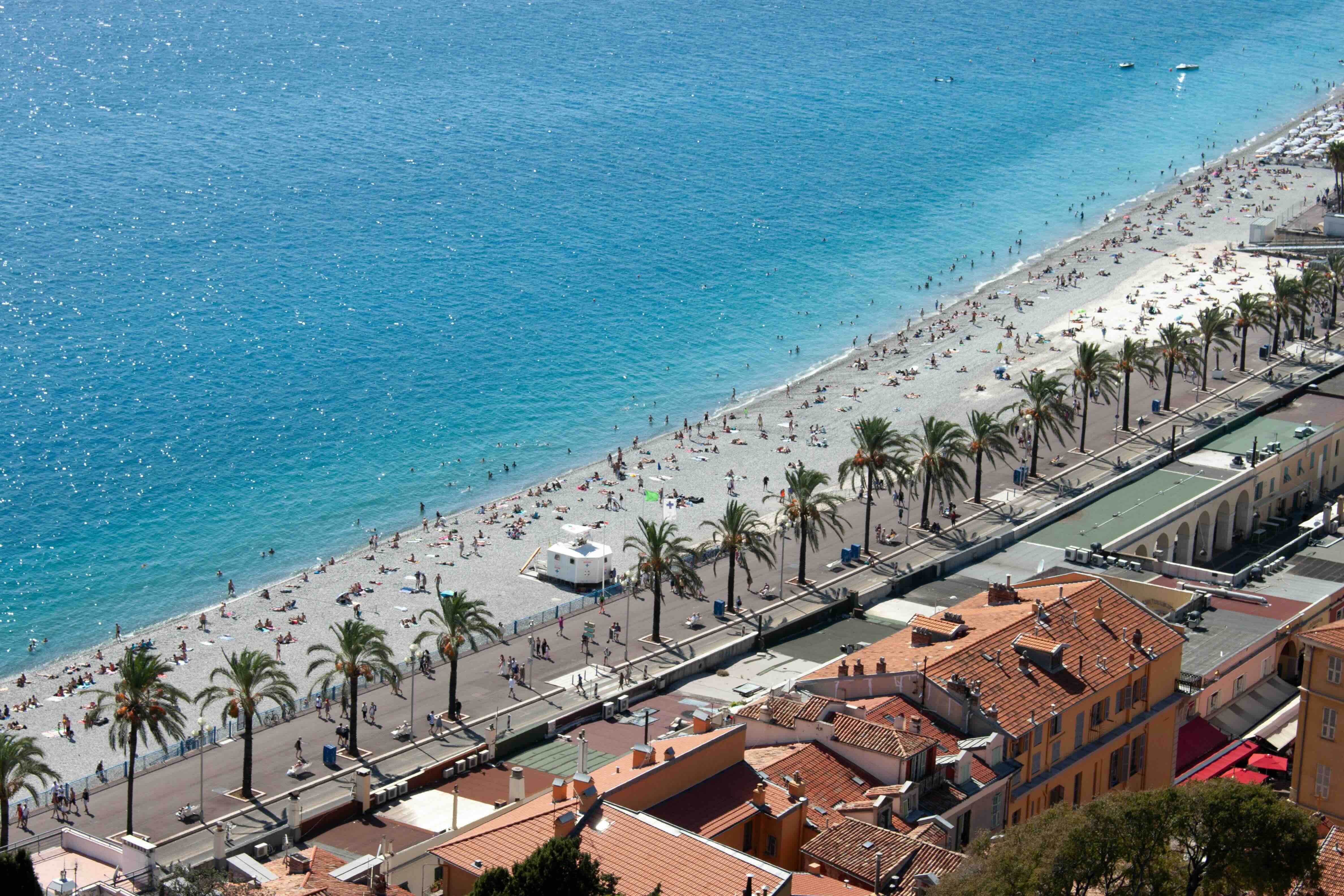
Marseille → Nice
~2h 30m · TER / TGV INOUI (SNCF)
Arrive in Nice along the Riviera from Marseille
View Route
Interrail and the Swiss Travel Pass — when a pass beats point-to-point tickets and when it does not.
When reservation is mandatory, which side of the train has the views, and how to choose your class.
Nice to Milan is the Riviera crossing from France into Italy: around five and a half hours from the Cote d'Azur to Italy's business capital, along the sea past Monaco and Menton, over the border at Ventimiglia, and up the Italian coast through Genoa to Milan. Treat the French leg as flexible and the Italian leg as booked, allow time for the change, take the right-hand side by daylight for the coast - and remember that Milan is a beginning, with all of Italy a platform away.
Back to all routes