
Lyon to Marseille
From the Rhone Valley to the Mediterranean
Lyon to Marseille is France's high-speed run to the sea: around 1 hour 40 minutes down the Rhone corridor on the LGV Mediterranee, from the business heart of Lyon to a station perched above the old port of Marseille. The train follows the great river the whole way south, and somewhere along it the light, the language of the landscape and the smell of the air all quietly turn Mediterranean.
It is a journey with a strong sense of direction. You leave the Rhone-Alpes and arrive in Provence; you step off in Lyon's cool grey north and out into the glare and blue of the south. And Marseille is not the end of the line so much as the doorway to it: from Saint-Charles the whole of the Midi opens up, with fast trains and ferries fanning out to Aix, Avignon, the calanques, the Riviera and Corsica. This is the route that turns "the south of France" from an idea into a place you can reach by lunchtime.
Why the train wins here: City centre to city centre in well under two hours, against a flight that needs two out-of-town airports and their transfers - the TGV is comfortably quicker door to door, and it drops you at the top of the staircase down into Marseille rather than miles away.
Ready to book Lyon to Marseille?
Every TGV on this line is all-reserved, so book ahead - fares are dynamic and the cheapest seats go first, with summer weekends and Friday evenings filling earliest. TGV INOUI is the full-service option; OUIGO is the low-cost alternative with stricter luggage rules that sometimes uses Lyon Saint-Exupery rather than Part-Dieu. Interrail passes work on TGV INOUI with a compulsory paid reservation; OUIGO does not accept passes.
Railero may earn a small commission if you book via the link above, at no extra cost to you.
Departing Lyon Part-Dieu
Lyon Part-Dieu, France · 45.760°N, 4.860°E
Most southbound trains leave from Lyon Part-Dieu, the busy hub in the modern business district on the left bank of the Rhone - metro line B and several tram lines run beneath and beside it, so it is quick to reach from anywhere in the city. It is a working station rather than a beautiful one, and often under some form of rebuilding, so give yourself a couple of extra minutes to find your platform among the crowds.
Boarding is simple and there is no airport-style check-in: arrive fifteen to twenty minutes ahead, watch the boards for your platform (shown shortly before departure), and find your coach. One thing to confirm on your ticket - a few services, OUIGO especially, use Lyon Saint-Exupery, the airport TGV station east of the city, rather than Part-Dieu. Check which Lyon station is printed on your ticket before travel day.
Lyon–Marseille - Journey Facts
- RouteLyon Part-Dieu → Marseille Saint-Charles, via the LGV Mediterranee
- OperatorsTGV INOUI (full service) and OUIGO (low cost); slower TER also runs
- Journey timeAround 1h 40m direct - a little less on the fastest trains
- DistanceAbout 280 km down the Rhone corridor, at up to 320 km/h
- FrequencyMany trains daily through the day - timetable-dependent
- ReservationsCompulsory - every TGV is all-reserved
Following the Rhone Valley South
The Rhone valley past Valence · 44.993°N, 4.978°E
Out of Lyon the train picks up the Rhone and runs south with it - the river that has been the road to the Mediterranean since the Greeks and Romans, and still the natural corridor through the hills. For the first stretch the high-speed line shares the valley with vineyards and the wide, braided river, passing Valence, the point locals only half-jokingly call the start of the south: the roofs turn to Roman tile, the plane trees appear, and the accent shifts.
This is fast, easy travelling rather than a dramatic mountain ride - the LGV was built for speed - but the sense of moving somewhere is strong. You are descending the spine of France toward the sea, and the landscape loosens and brightens with every few minutes: drier hills, silver olive and cypress, the first lavender country away to the east.
The Rhone has carried travellers south for two thousand years; the TGV simply does the same trip before lunch.
Avignon and the Gateway to Provence
Avignon TGV · 43.921°N, 4.786°E
By the time the line reaches Avignon TGV, out on the edge of the city, you are unmistakably in Provence. Avignon is the classic gateway to the region - the walled Papal city, the broken bridge, and behind it the Luberon hills and their perched villages - and a fair number of Lyon-Marseille trains stop here, making it an easy hop off the route for a first taste of the south.
Even if your train runs straight through, the change is written on the landscape from the window: the light hardens and whitens, the vegetation goes to scrub and stone pine, and the horizon fills with the pale limestone ridges that Provence is built from. From here the line curves away from the Rhone and heads for the coast.
Aix-en-Provence and the Final Approach
Aix-en-Provence TGV · 43.455°N, 5.317°E
The last inland stop is Aix-en-Provence TGV, marooned in the garrigue north of the city it serves - this is Cezanne country, with Mont Sainte-Victoire's white ridge often visible to the east, the mountain he painted more than sixty times. Aix itself, elegant and fountain-filled, is a short hop away and one of the best onward connections from the route.
Beyond Aix the train makes its final run toward the coast, threading tunnels through the last hills, and the anticipation builds: Marseille sits in a great limestone amphitheatre facing the sea, and the descent into it is the moment the whole journey has been pointing at. Then the platforms of Saint-Charles slide alongside, and you have arrived at the Mediterranean.
Worth Knowing
Arriving at Marseille Saint-Charles
Marseille Saint-Charles, France · 43.303°N, 5.381°E
Marseille Saint-Charles is a terminus with a sense of theatre. It sits on a rise above the city, and the way down is the famous escalier monumental - the monumental staircase built in 1925, its balustrades lined with statues, sweeping from the station forecourt down into the streets below. Walk out of the trainshed, cross the forecourt, and the whole city and its light open up in front of you at the top of the steps.
It is also ruthlessly practical. Metro lines 1 and 2 run directly beneath the station, putting the Vieux-Port - the old harbour that is the heart of Marseille, about 2 km away - a few minutes down the line, or a twenty-minute downhill walk. Trams and city buses stop outside, coaches run to Marseille Provence airport, and the station is staffed and step-free, with SNCF's Assist'enGare service bookable ahead for platform assistance. For a first-time arrival, take the staircase at least once; for everything after, the metro beneath it does the work.
From Marseille Saint-Charles
TGV INOUI or OUIGO - and Which Class
Two products on the same line: how to choose
Two kinds of TGV run this route. TGV INOUI is SNCF's full-service train: first and second class, a bar car, generous luggage, flexible fares and departures from Lyon Part-Dieu. OUIGO is the low-cost brand - same high-speed line, much lower fares, but a single class, strict luggage rules (one cabin bag plus a small personal item, with extras paid for), no bar car, less flexibility, and often a departure from Lyon Saint-Exupery rather than Part-Dieu. Neither is better in the abstract: OUIGO wins on price for light-packing, plan-ahead travellers, while INOUI wins on comfort, flexibility, luggage and city-centre convenience.
On TGV INOUI the class question is easy for a trip this short. Second class is perfectly comfortable for under two hours, with power at every seat; first class buys a 1+2 layout with wider seats, more space and a quieter carriage, often for only a modest premium when booked early - worth it if you are working or want to arrive fresh, optional otherwise. OUIGO is single-class, so there the choice is simply whether its fares and rules suit your trip.
TGV INOUI vs OUIGO
- ServiceINOUI: full service, bar car, 1st/2nd class · OUIGO: low-cost, single class
- LuggageINOUI: generous, no strict limit · OUIGO: size-limited, extras paid
- FlexibilityINOUI: exchangeable fares available · OUIGO: cheaper but stricter
- Lyon stationINOUI: Part-Dieu · OUIGO: often Saint-Exupery airport - check your ticket
- Rail passesINOUI with paid reservation · OUIGO not accepted
Why Marseille Is More Than a Destination
The hub of the French Mediterranean
Arriving in Marseille, it is tempting to think of it as the end of the line. It is really the opposite - the transport heart of the French Mediterranean, from which the whole of the south is within easy reach. Saint-Charles is one of the busiest interchanges in France, and a great deal of what makes Provence and the Cote d'Azur reachable passes through it. The route from Lyon is, in effect, the first leg of a dozen onward journeys.
The connections split into three kinds. Frequent regional TER trains handle the near south - Aix, Cassis and the calanques, Toulon - with no reservation needed. High-speed and coastal trains run east along the Riviera to Cannes and Nice, and on toward the Italian border. And from the port, a short metro ride from the station, ferries sail to Corsica. Some connections are direct and some need a change, so it is worth checking each, but the principle holds: reach Marseille and the Midi is open.
Onward from Marseille
- Aix-en-ProvenceFrequent TER, around 40 min - reservation-free
- AvignonTGV in about 35 min, or slower TER to Avignon Centre
- Cassis & the calanquesTER along the coast, around 25 min
- ToulonFrequent trains, roughly 45 min to an hour
- Cannes & NiceCoastal TGV and Intercites east - Nice around 2h 30m
- Corsica ferriesFrom the port near the station - Ajaccio and Bastia by sea
- Toward ItalyEast along the Riviera to Ventimiglia, then Italian trains
Marseille is not where the journey stops - it is where the south of France begins.
Reservations, Luggage, Bikes and Access
The practical rules for a French high-speed trip
The reservation rule is absolute: TGV is all-reserved, so every ticket is for a specific train with an assigned seat and there is no boarding an earlier or later one on the same ticket. For pass holders, Interrail is accepted on TGV INOUI with a compulsory paid reservation from a limited quota - book it as early as you can, because the quota sells out well before the train does, and OUIGO does not accept passes at all. The regional TER trains around Provence are the easy exception: reservation-free and fully pass-covered. For the wider picture, see the rail passes and seat reservations guides linked below.
Everything else is low-stress. Luggage on TGV INOUI is unregulated in practice - bring what you can carry and use the racks, with no weigh-ins - while OUIGO applies its size-limited allowance. Bikes need planning: folding bikes travel free in a bag on both, but a full bike needs a dedicated bike space that only some TGVs offer and that must be reserved, so check the operator's current policy before turning up with one. For step-free travel and platform help, SNCF's Assist'enGare service can be booked ahead at both Lyon Part-Dieu and Marseille Saint-Charles, both of which are staffed; assistance is best arranged in advance where you can.
Quick Tips
Book early: dynamic fares reward booking ahead - the same seat costs far less weeks out than on the day.
Check your Lyon station: TGV INOUI leaves Part-Dieu; OUIGO often uses Saint-Exupery airport - confirm before you travel.
Take the staircase: at Marseille, walk down the escalier monumental once for the arrival; the metro beneath handles the rest.
Hotels in Marseille
Marseille rewards staying near the water - the Vieux-Port and the Panier old town put you among the harbour, the markets and the ferries, a short metro ride below Saint-Charles.
Marseille - above the Vieux-Port
The grand 18th-century former hospital reborn as the city's showpiece hotel, on the hill over the old port with terrace views across the harbour - Marseille's finest address.
Marseille - on the Vieux-Port
A polished, well-run hotel right on the old port quay, walkable to the markets and the ferries and a few minutes by metro from Saint-Charles - the practical central pick.
Marseille - by the Vieux-Port
A friendly, fairly priced hotel a street back from the harbour with a rooftop terrace over the port - dependable value within walking distance of everything central.
Hotel links open Booking.com. Railero may earn a commission on bookings at no extra cost to you.
Frequently Asked Questions
- How long is the train from Lyon to Marseille?
- A direct TGV takes around 1 hour 40 minutes, with the fastest services doing it in a little under that. Trains that call at intermediate stops such as Valence, Avignon or Aix-en-Provence TGV take a few minutes more. TER trains are much slower. Exact times vary by service, so check current schedules when you book.
- Is the Lyon to Marseille train direct?
- Yes - most high-speed services run direct on the LGV Mediterranee down the Rhone corridor. Some call at one or two of the intermediate TGV stations, but you stay on the same train the whole way; no change is needed.
- Which stations do the trains use?
- Trains leave from Lyon Part-Dieu, the city's main business-district station, and arrive at Marseille Saint-Charles, the terminus above the old town. A few services also call at or start from Lyon Saint-Exupery, the airport TGV station, so check which Lyon station is on your ticket.
- Is TGV INOUI or OUIGO better for this route?
- It depends on what you value. TGV INOUI is the full-service option - first and second class, a bar car and flexible fares. OUIGO is the low-cost alternative with lower fares but stricter luggage rules, a single class and less flexibility, and it sometimes uses Lyon Saint-Exupery rather than Part-Dieu. Neither is universally better: choose on price, luggage and flexibility.
- Do I need to reserve a seat?
- Yes - every TGV, whether INOUI or OUIGO, is all-reserved. Your ticket is tied to a specific train with an assigned seat, and you cannot board an earlier or later train on the same ticket. Book ahead, as fares are dynamic and the cheapest seats sell first.
- Can I use an Interrail pass?
- On TGV INOUI yes, with a compulsory paid pass-holder reservation from a limited quota, so book it early. OUIGO does not accept rail passes at all. The regional TER trains around Provence - to Aix-en-Provence, Cassis and along the coast - are reservation-free and pass-friendly.
- How do I get from Marseille Saint-Charles into the city?
- The station sits above the centre, and the monumental staircase at the exit leads straight down into town. Metro lines 1 and 2 run directly beneath the station, trams and buses stop outside, and the Vieux-Port (Old Port) is about 2 km away - a short metro ride or a downhill walk of 20-25 minutes.
- Can I continue from Marseille to the rest of the south of France?
- Easily - Marseille Saint-Charles is the hub of southern France. Frequent TER trains reach Aix-en-Provence, Cassis and Toulon, TGV and coastal trains continue to Toulon, Cannes and Nice, and the Corsica ferries leave from the port nearby. There are also onward services east along the Riviera toward the Italian border.
- How early should I arrive at the station?
- For a domestic TGV there is no airport-style check-in, so 15-20 minutes is plenty to find your platform and board. Platform numbers are typically shown on the departure boards shortly before departure, so watch the boards rather than heading to a platform too early.
- Can I take luggage or a bicycle?
- Luggage on TGV INOUI is generous with no strict weight limit - you carry bags aboard and use the racks; OUIGO applies a size-limited allowance with paid extras. Folding bikes travel free in a bag on both, while a full bicycle needs a dedicated bike space that only some TGVs offer and that must be reserved, so check the operator's current policy before travelling with one.
Continue Your Journey
Routes that pair naturally with this one — for building your European itinerary.
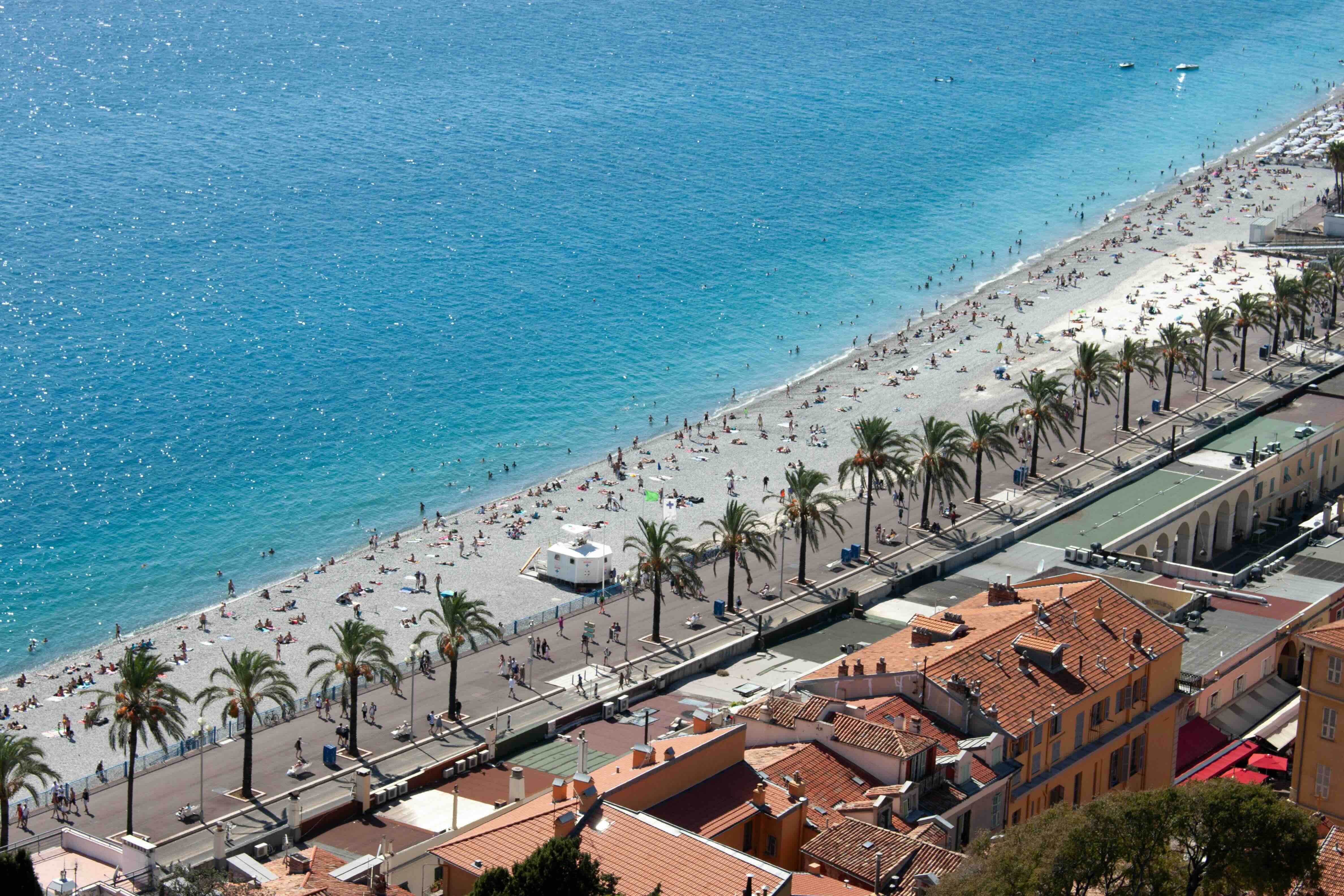
Marseille → Nice
~2h 30m · TER / TGV INOUI (SNCF)
Continue east along the coast: Marseille to Nice
View Route
Interrail and the Swiss Travel Pass — when a pass beats point-to-point tickets and when it does not.
When reservation is mandatory, which side of the train has the views, and how to choose your class.
Lyon to Marseille is the fast way to the Mediterranean: an hour and three-quarters down the Rhone from the heart of one great city to the staircase above another, and the start of everything the south of France has to offer. Compare TGV INOUI and OUIGO, book early for the fare, and remember that Marseille is a beginning - Aix, the calanques, the Riviera and Corsica all leave from where you arrive.