Rome to Venice
The Italian High-Speed Spine
Three hours and forty-five minutes separates the Eternal City from the floating one. Trenitalia's Frecciarossa - the red arrow - threads the Italian peninsula from Roma Termini to Venezia Santa Lucia, arriving not at an airport 12 kilometres from the city, but at a station built directly onto the islands of Venice.
This is Italy's flagship intercity link - and the case for the train over the plane is compelling in a way that few European routes can match. Fly to Venice Marco Polo and you land 12 kilometres across the lagoon from the islands, then still face a paid water transfer to reach your hotel. The Frecciarossa delivers you to Santa Lucia - on the islands, a two-minute walk from the Grand Canal - with no transfer, no ferry, no queue.
The airport transfer problem: from Marco Polo, private water taxis typically cost significantly more than public transport options, and even the cheaper airport boat and bus connections add the best part of an hour. The Frecciarossa arrives directly on the islands. This changes the economics of the entire journey.
Ready to book Rome → Venice?
Check live Frecciarossa fares. The train deposits you at Venezia Santa Lucia - on the island, steps from the Grand Canal - with no water taxi required.
Railero may earn a small commission if you book via the link above, at no extra cost to you.
Train vs Plane — The Real Numbers
Adjust the fares to match your search results. Time includes Marco Polo water taxi to Venice island.
Train costs
Flight costs
The Frecciarossa deposits you at Venezia Santa Lucia — on the island, steps from the Grand Canal. No water taxi queue, no luggage on a vaporetto.
Example costs are based on typical advance bookings and city-centre transfers. Actual prices vary by date, operator and travel demand.
Roma Termini - Departure in the Heart of Rome
Rome, Italy · 41.900°N, 12.501°E
Roma Termini is one of Europe's largest railway stations - a vast Mussolini-era structure that was completed in 1950 and has aged into something genuinely grand. The departure hall is 280 metres long, flooded with natural light through a curved glass roof, and connected by underground passages to Rome's metro network. You arrive from the city centre and walk directly to the Frecciarossa platforms without touching a taxi or a transfer.
The Frecciarossa - literally "red arrow" - is Trenitalia's flagship. The FS ETR1000 operates at up to 300 km/h on Italy's high-speed network. On the Rome–Venice route, average commercial speed is around 140 km/h as the train navigates the Apennines, but the service compensates with comfort: wide seats, generous legroom, a full bistrot car, and power sockets at every seat.
The Frecciarossa arrives at Venice's islands, not at an airport 12 kilometres across the lagoon.
Frecciarossa classes
- Standard— Comfortable reclining seats, power socket, Wi-Fi
- Premium— Wider seats, more legroom, priority boarding
- Business— Meal included at seat, 2×2 layout, private feel
- Executive— 2+1 seating, dedicated lounge car access
Firenze - The Renaissance at Speed
Florence, Italy · 43.776°N, 11.248°E
Around 90 minutes from Rome, the train calls at Firenze Santa Maria Novella - Florence's central station, a masterpiece of Italian Rationalist architecture completed in 1935 by Giovanni Michelucci. The station sits a ten-minute walk from the Duomo, and most Rome–Venice services stop here for two to three minutes.
This is the halfway mark of the Italian High-Speed Spine. South of Florence the line climbs through the Apennines - a stretch of tunnels and viaducts that hides the engineering achievement of cutting high-speed rail through mountain terrain. North of Florence the train emerges into the Po Valley, and the landscape opens dramatically: flat, misty, agricultural plains stretching to distant Alps.
The Po Valley is one of those landscapes that reads differently from a train than from a car - the scale and flatness of it, the straight lines of the rivers, the poplars, the fog that sits above the fields in winter. Bologna Centrale, another brief stop, marks the Po Valley in its fullness. Then Padova, the medieval university city, 30 minutes from Venice.
North of Florence the world flattens into the Po Valley - Italy's great agricultural plain - and Venice is close.
Venezia Santa Lucia - Arrival on the Islands
Venice, Italy · 45.441°N, 12.321°E
The approach to Venice is one of the great arrivals in European rail travel. The train crosses the Ponte della Libertà - the four-kilometre causeway that connects the mainland to the Venetian islands - at reduced speed, and through the carriage window the lagoon appears on both sides simultaneously. There is no equivalent experience in flying.
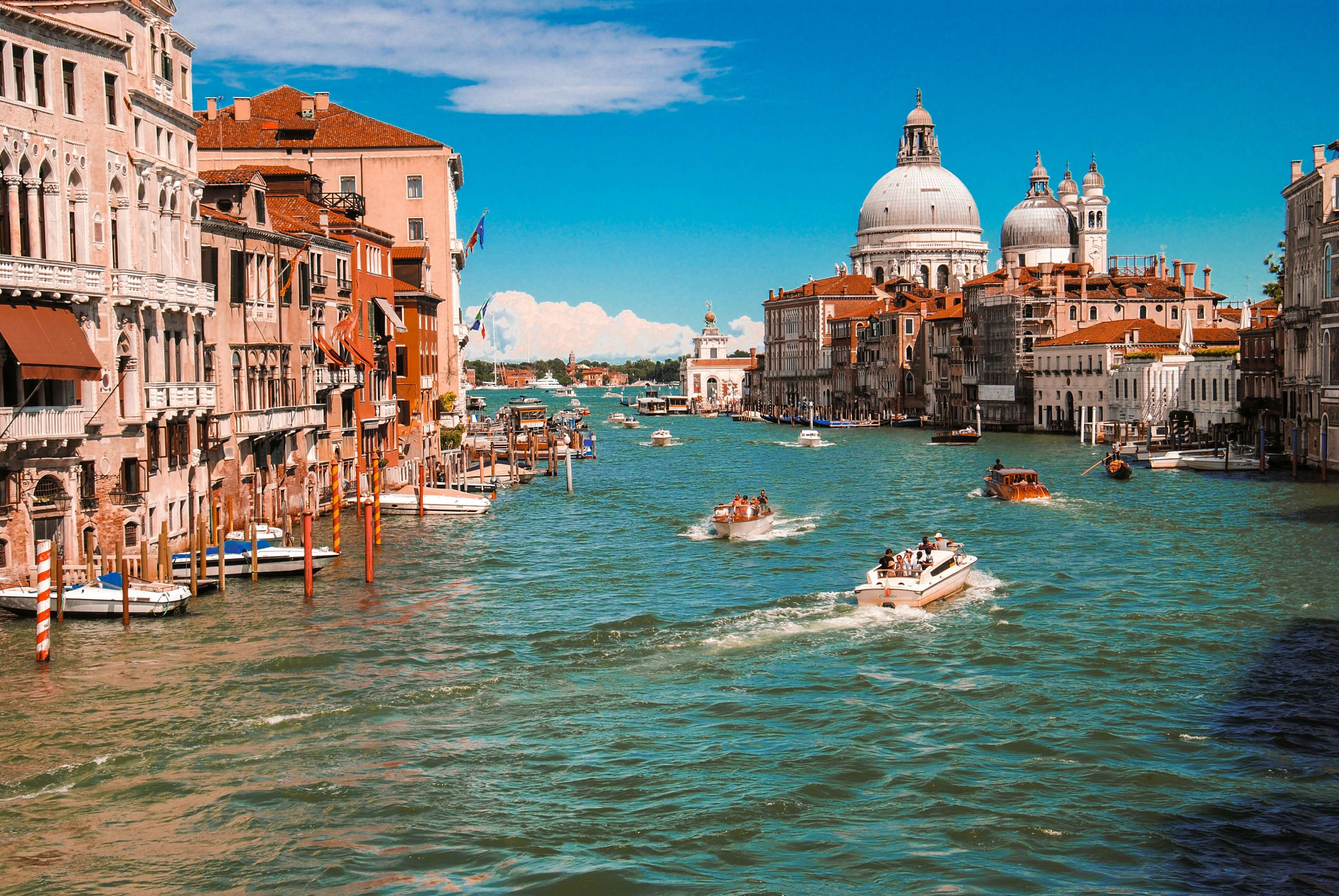
Venezia Santa Lucia station was completed in 1934 and sits at the western end of the Grand Canal. Step off the train, walk through the station doors, and the Grand Canal is directly in front of you. Gondolas, vaporetti, and private water taxis pass twenty metres from the station's steps. You are already in Venice, on the islands, without any secondary transfer.
From Venezia Santa Lucia
Stay on the islands - Cannaregio, Dorsoduro, San Polo, or Castello. Hotels on the Venetian Lagoon mainland (Mestre) are cheaper but remove you from the city entirely. The train makes island hotels accessible to any budget by eliminating the most expensive part of the flight journey: the water taxi from Marco Polo.
Venice Island Hotels
Arriving by train sets you down on the Venetian islands themselves. Every property below is on the islands, reachable by vaporetto or water taxi from Santa Lucia - no mainland stay in Mestre, no missed mornings on the canals.
Riva degli Schiavoni - near San Marco
A former Venetian palazzo on the waterfront a short walk from Piazza San Marco, reached by vaporetto or water taxi from Santa Lucia.
Santa Maria del Giglio - Grand Canal
A canal-side palazzo directly on the Grand Canal with its own water-taxi landing, a few minutes by boat from the station.
San Polo - near the Frari
A quiet garden villa in San Polo beside the Frari church, a few minutes on foot from a Grand Canal vaporetto stop.
Hotel links open Booking.com. Railero may earn a commission on bookings at no extra cost to you.
Frequently Asked Questions
- How long is the train from Rome to Venice?
- The fastest Frecciarossa services take 3 hours 45 minutes from Roma Termini to Venezia Santa Lucia. Some services with additional stops take around 4 hours - check the journey time when booking.
- Which Venice station does the train arrive at?
- Trains arrive at Venezia Santa Lucia, on the Venetian islands at the head of the Grand Canal. Take care not to confuse it with Venezia Mestre, the mainland station one stop earlier.
- Do I need to change trains between Rome and Venice?
- No. Frecciarossa services run direct from Roma Termini to Venezia Santa Lucia, typically calling at Firenze Santa Maria Novella, Bologna Centrale, and Padova along the way.
- Is the train better than flying from Rome to Venice?
- For most travellers, yes. Venice Marco Polo airport is on the mainland, so flying still leaves a paid water or road transfer to the islands, while the train arrives directly at Santa Lucia. Door-to-door times are comparable - and rail produces roughly 90% less CO2 per passenger than the equivalent flight.
- How far in advance should I book Rome to Venice trains?
- Booking 1–2 months ahead secures the cheapest Super Economy fares, which sell out quickly on peak services. Both Trenitalia and Italo operate the route, so comparing the two operators often saves money.
Not sure if you need to reserve a seat?
Check this journey in Railero’s Seat Reservation Checker.
Continue Your Journey
Routes that pair naturally with this one — for building your European itinerary.
How to find the best fares, which operators to book with, and when advance booking makes the difference.
Interrail and the Swiss Travel Pass — when a pass beats point-to-point tickets and when it does not.
Rome to Venice by Frecciarossa is one of Italy's definitive rail journeys - and one of the clearest cases in Europe for choosing the train over the plane. The destination is an island city. The train is the only long-distance transport mode that arrives directly on the Venetian islands - and it produces roughly 90% less CO2 per passenger than the equivalent flight.