Paris to Milan by Train
Direct TGV INOUI and Frecciarossa through the Alps
Two operators run direct high-speed trains from Paris Gare de Lyon to Milan: SNCF's TGV INOUI and Trenitalia's Frecciarossa. The journey takes around 7 hours, across Burgundy and Savoie, up the Maurienne valley and through the Fréjus rail tunnel into Italy, with a stop in Turin before Milan.
The two operators sell their own tickets, stop at slightly different places and arrive at different stations in Milan, so it pays to know which train you are on. This guide covers the direct trains and how to choose between them, the Alpine route, tickets, reservations and Interrail, engineering closures, and arriving at Milano Centrale or Porta Garibaldi.
Check your date: the line through the Alps is sometimes closed for engineering work, and the current timetable runs until 12 December 2026.
Book Paris to Milan
Omio shows the direct TGV INOUI and Frecciarossa trains side by side, along with slower journeys with changes, so check that the train you choose is shown as direct and note which Milan station it arrives at. You can also book directly with each operator: SNCF Connect for the TGV INOUI and Trenitalia for the Frecciarossa. Both trains are all-reserved, so your ticket includes a seat, and fares generally rise as the train fills.
Railero may earn a small commission if you book via the link above, at no extra cost to you.
The Direct Trains from Paris Gare de Lyon
Paris Gare de Lyon, France · 48.844°N, 2.373°E
Every direct train to Milan leaves from Paris Gare de Lyon, the station for south-east France, the Alps and Italy. Two operators share the route. SNCF runs TGV INOUI trains, and Trenitalia runs Frecciarossa trains, Italy's high-speed brand, which cross the border into France on this line.
In the current timetable there are usually around five direct trains a day in each direction between the two operators, spread from early morning to mid-afternoon, though the exact number and times vary from date to date. Whichever you choose, the journey takes around 7 hours, and every direct train also stops in Turin.
Current Timetable (to 12 December 2026)
- RouteParis Gare de Lyon → Turin → Milan, no change
- OperatorsSNCF TGV INOUI and Trenitalia Frecciarossa
- Direct trainsUsually around five a day each way, varying by date
- Journey timeAround 7 hours - check current schedules
- Milan stationFrecciarossa: Centrale; TGV INOUI: Porta Garibaldi
- ReservationsAll seats reserved; included with every ticket
TGV INOUI or Frecciarossa: How to Choose
Two operators, one line through the Alps
The two trains share most of the route but are not identical. The Frecciarossa stops at Lyon Part-Dieu, then runs on to Chambéry and the Alps. The TGV INOUI does not stop in Lyon: it leaves the high-speed line further north, sometimes stopping at Mâcon-Loché TGV, and reaches Chambéry by a different line. From Chambéry onward they follow the same tracks to Turin.
The biggest practical difference is at the end. The Frecciarossa terminates at Milano Centrale, the city's main station, while the TGV INOUI terminates at Milano Porta Garibaldi. Both are well connected, but your hotel, onward train and return journey may make one more convenient than the other. Both trains have a bar on board.
TGV INOUI vs Frecciarossa
- OperatorSNCF (TGV INOUI) · Trenitalia (Frecciarossa)
- Stops at LyonFrecciarossa only, at Lyon Part-Dieu
- Stops in ItalyBoth: Oulx and Torino Porta Susa
- Milan stationTGV INOUI: Porta Garibaldi · Frecciarossa: Centrale
- Where to bookSNCF Connect · Trenitalia · Omio for both
- Rail passesBoth, with a paid pass-holder reservation
Into the Alps: the Maurienne and the Fréjus Tunnel
Savoie, France, into Piedmont, Italy
After a fast run south-east from Paris on the high-speed line, the trains slow down for the mountains. Chambéry, the old capital of Savoie, is the gateway: from here the line climbs east up the Maurienne valley, with some trains stopping at Saint-Jean-de-Maurienne, to Modane, the last stop in France.
Beyond Modane the train passes through the Fréjus rail tunnel, also called the Mont Cenis tunnel, under the main ridge of the Alps, and emerges in Italy near Bardonecchia. It stops at Oulx, the station for ski resorts including Sestriere and Claviere, then descends the Susa valley to Turin. This is the most scenic part of the trip, so try to travel in daylight.
Engineering Closures
Planned closures: the line through the Maurienne is sometimes closed for maintenance, and direct trains do not run while it is. A closure from 12 September to 9 October 2026 stops all direct trains between France and Italy; operator timetables show direct trains from 10 October.
Fewer trains on some dates: the timetable varies from date to date, so check your exact day.
History: after a landslide in the Maurienne in August 2023, direct trains did not run for well over a year, returning in spring 2025.
Turin: Every Train Stops at Porta Susa
Torino Porta Susa, Italy · 45.072°N, 7.666°E
All the direct trains stop at Torino Porta Susa, Turin's modern through station, about 5 hours 30 minutes to 6 hours from Paris. That makes Turin a destination in its own right on the same trains, or a natural place to break the journey for a night before continuing to Milan, about an hour to an hour and a half further on.
From Turin the trains run east across the Po plain on the high-speed line to Milan. The scenery flattens out here, with rice fields around Novara and Vercelli, so the Alps are behind you.
Tickets, Reservations and Interrail
Where to book, seats and rail passes
Both operators' trains are all-reserved: every ticket is for a specific train and includes a seat, so there is nothing extra to book. You can buy the TGV INOUI from SNCF Connect, the Frecciarossa from Trenitalia, or compare both on Omio. Fares generally rise as departure approaches and the train fills, so it usually pays to book ahead.
Interrail and Eurail passes are accepted on both, but a paid pass-holder reservation is compulsory, and the fee differs between the TGV INOUI and the Frecciarossa. Places for pass holders can sell out on busy dates, so reserve early. France and Italy are both in the Schengen area, so the border is normally open, though identity checks are possible, so keep your travel documents to hand.
Quick Rules
Check it is direct: planners also show slower journeys with changes, often via Switzerland.
Check the station: Milano Centrale or Milano Porta Garibaldi, depending on the operator.
Interrail: valid on both, with a compulsory paid pass-holder reservation.
Arriving in Milan: Centrale or Porta Garibaldi
Milano Centrale, Italy · 45.486°N, 9.204°E
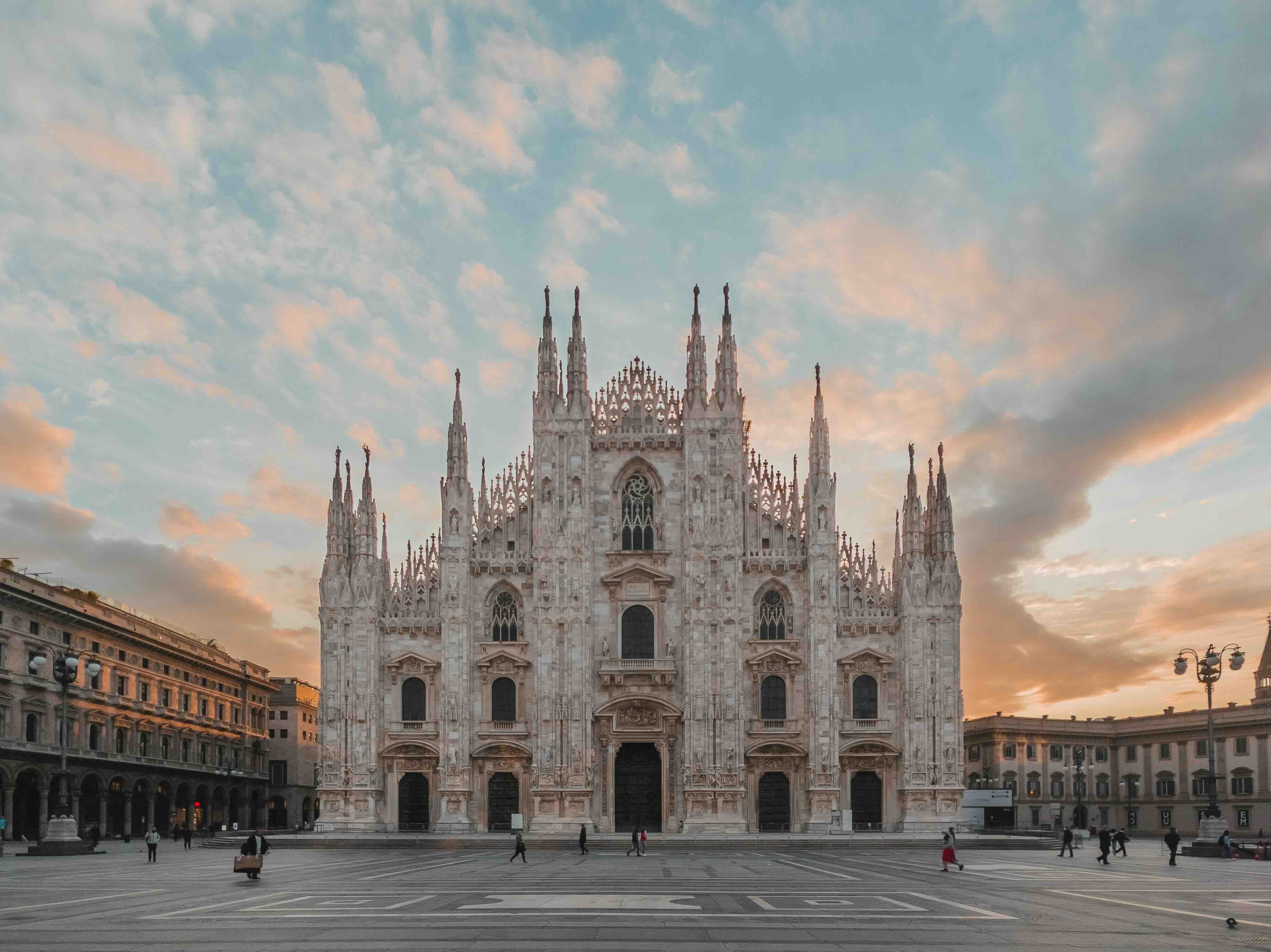
The Frecciarossa ends at Milano Centrale, the vast 1930s station north-east of the centre and Milan's main hub for high-speed trains to Venice, Florence and Rome. The TGV INOUI ends at Milano Porta Garibaldi, a short distance to the west, beside the Porta Nuova towers and close to the Corso Como and Brera areas.
The two stations are a couple of stops apart on metro line M2, and both have good metro links to the Duomo and the rest of the city. When you book a return to Paris, check which station your train leaves from.
From the Milan Stations
Hotels in Milan
Stay near the station you arrive at, or more centrally around the Duomo and Brera, a short metro ride from both Centrale and Porta Garibaldi.
Milan - Piazza della Repubblica
Milan's grand historic hotel on Piazza della Repubblica, between Milano Centrale and Porta Garibaldi - the classic luxury address, close to both arrival stations.
Milan - beside the Duomo
A stylish design hotel steps from the Duomo and the Galleria, in the very heart of the city - central and walkable, an easy metro ride from either station.
Milan - at Milano Centrale
A dependable, well-priced modern hotel by Milano Centrale - a practical base if you arrive on the Frecciarossa or are catching an onward train.
Hotel links open Booking.com. Railero may earn a commission on bookings at no extra cost to you.
Frequently Asked Questions
- Is there a direct train from Paris to Milan?
- Yes. Two operators run direct high-speed trains from Paris Gare de Lyon to Milan through the Alps: SNCF's TGV INOUI and Trenitalia's Frecciarossa. In the current timetable there are usually around five direct trains a day in each direction between them, though the number varies by date and some days have fewer. The current timetable runs until 12 December 2026, so check your date before booking.
- How long does the train from Paris to Milan take?
- Around 7 hours on the direct trains, typically between about 6 hours 45 minutes and 7 hours 20 minutes depending on the train and its stops. Turin is reached in about 5 hours 30 minutes to 6 hours. Check current times when you book.
- Should I take the TGV INOUI or the Frecciarossa?
- Both are direct, all-reserved high-speed trains taking around 7 hours, so the choice usually comes down to departure time, fare and arrival station. The Frecciarossa stops at Lyon Part-Dieu and ends at Milano Centrale. The TGV INOUI does not stop at Lyon and ends at Milano Porta Garibaldi. Each operator sells its own trains, and Omio shows both.
- Which stations do the trains use in Paris and Milan?
- Both operators leave from Paris Gare de Lyon. In Milan they arrive at different stations: the Frecciarossa at Milano Centrale and the TGV INOUI at Milano Porta Garibaldi. The two Milan stations are a couple of stops apart on metro line M2, so check your ticket for the right one, especially for the return journey.
- Do I need a seat reservation?
- Yes, but a normal ticket already includes it. Both the TGV INOUI and the Frecciarossa are all-reserved, so every ticket is for a specific train and comes with a seat. There is no separate reservation to buy unless you travel with a rail pass.
- Can I use Interrail between Paris and Milan?
- Yes. Interrail and Eurail passes are accepted on both the TGV INOUI and the Frecciarossa, but a paid pass-holder reservation is compulsory on both, and the fee differs between the two operators. Places for pass holders can be limited, so book the reservation early.
- Does the Paris to Milan train stop in Turin and Lyon?
- All the direct trains stop at Torino Porta Susa, so Turin is easy to reach on the same trains. Only the Frecciarossa stops at Lyon Part-Dieu; the TGV INOUI does not stop in Lyon. Both also call at Chambéry, Modane and Oulx, and some trains stop at Saint-Jean-de-Maurienne or Mâcon-Loché TGV.
- Is the line ever closed for engineering work?
- Yes. The line through the Maurienne valley and the Fréjus rail tunnel is sometimes closed for maintenance, and direct trains do not run while it is. A closure from 12 September to 9 October 2026 stops all direct trains, with operator timetables showing direct trains from 10 October, and some dates have fewer trains. The line was also closed for many months after a landslide in 2023. Check your date with the operator before you travel.
Continue Your Journey
Routes that pair naturally with this one — for building your European itinerary.
Interrail and the Swiss Travel Pass — when a pass beats point-to-point tickets and when it does not.
When reservation is mandatory, which side of the train has the views, and how to choose your class.
Paris to Milan is a genuine direct trip: TGV INOUI and Frecciarossa trains run from Paris Gare de Lyon through the Alps in around 7 hours, all stopping in Turin. Choose by departure time, fare and arrival station, Porta Garibaldi for the TGV INOUI or Centrale for the Frecciarossa, and check your date, as the line is sometimes closed for engineering work.
Back to all routes