The Bergen Line
Oslo to Bergen
Around seven hours. Close to 500 kilometres. From the head of the Oslofjord, over the roof of the Hardangervidda at more than 1,200 metres, and down through waterfalls and fjord country into Bergen. The Bergensbanen is routinely counted among the greatest train journeys in Europe - and it earns the title in a single day.
The Bergen Line was completed in 1909, when the last section over the mountains linked the coastal city of Bergen with the capital. At the time it was the highest mainline railway in northern Europe, and it still crosses the same treeless plateau it was built to conquer - the Hardangervidda, the largest high-mountain plateau on the continent. What makes the journey extraordinary is not one view but the transformation: forest and farmland give way to lakes, then to bare Arctic-like tundra around Finse, then to the green descent toward the sea. It is operated by Vy as an ordinary scheduled service, which means this world-class ride is also simply how Norwegians get between their two biggest cities.
Norway in a Nutshell: At Myrdal the Bergen Line meets the Flåm Railway (Flåmsbana), the dramatic branch down to the Aurlandsfjord. Combining the two - plus a fjord cruise and the leg via Voss - is the classic "Norway in a Nutshell" itinerary. Book the individual legs separately for the best fares and flexibility.
Ready to book Oslo to Bergen?
The Bergen Line is a normal Vy service, so it takes ordinary tickets and is open to Interrail pass holders. A seat reservation is strongly recommended - trains are popular and a window seat makes the journey. In summer, book well ahead. Schedules, fares and reservation rules can change, so confirm the current details when you book.
Railero may earn a small commission if you book via the link above, at no extra cost to you.
Example costs are based on typical advance bookings and city-centre transfers. Actual prices vary by date, operator and travel demand.
Oslo - Departure at the Head of the Fjord
Oslo Sentralstasjon (Oslo S), Norway · 59.911°N, 10.752°E
The journey begins at Oslo Sentralstasjon - Oslo S - the country's main rail hub at the head of the Oslofjord. It is a functional, well-connected station rather than a grand one: long-distance Bergen Line services share the concourse with the metro (T-bane) below and the airport express to Gardermoen. Arrive with a little time, pick up provisions for the crossing, and find your reserved carriage; the platforms are busy and the Bergen train is a long one.
For the first hour the train works west and inland - through Drammen and up into the forests and lake country of eastern Norway. This opening stretch is gentle and green, a slow gathering of altitude through Hønefoss and the Hallingdal valley toward the ski town of Geilo. It is the quietest scenery of the day, and the contrast it sets up is deliberate: the higher the train climbs, the more the trees thin, until they vanish entirely.
You board in a city on the fjord and, a few hours later, you are crossing bare Arctic-like tundra above the treeline - without changing trains once.
Bergen Line - Journey Facts
- OperatorVy (infrastructure by Bane NOR)
- Opened1909 (Bergen–Voss section from 1883)
- Length~496 km, Oslo → Bergen
- Highest point1,237 m across the Hardangervidda
- Highest stnFinse, 1,222 m - highest in northern Europe
- Journey time~7 hours; several departures daily
- Rail passesInterrail valid - reservation recommended
- Best seatViews switch sides; a window seat is the priority
Which Side of the Train?
The Bergen Line does not reward one fixed side: the highlights alternate, and the great open plateau around Finse is spectacular from both windows. If forced to choose, many favour the right-hand side heading west for the plateau and the descent toward the fjords. The real advice is simpler - reserve any window seat, keep the glass clear, and be ready to move to the far window on a quiet train when a waterfall or lake appears on the other side.
On the return, the same scenery unspools in reverse and the light is different - afternoon sun on the plateau, low gold over the Hallingdal forests toward Oslo. Travellers who want a general rule often pick the left-hand side eastbound. As westbound, though, the plateau shines from both sides, so prioritise a window over a specific side.
Finse & the Hardangervidda - Above the Treeline
Finse, Vestland, Norway · 60.602°N, 7.505°E · 1,222 m above sea level
Somewhere past Geilo the trees give out and the train climbs onto the Hardangervidda - the largest high-mountain plateau in northern Europe and a national park roughly the size of a small country. This is the heart of the journey: a vast, treeless expanse of rock, lichen, snowfields and pale lakes, crossed by a railway that seems impossibly exposed. Even in high summer there is snow in the hollows; in winter the whole plateau is a single white sheet, and the line only stays open because much of it is threaded through snowsheds and tunnels.
Finse, at 1,222 metres, is the highest station in northern Europe and the summit of the line. There is no road here - Finse is reached only by rail - and that isolation is exactly why people come. In summer it is a base for walking and cycling the Rallarvegen, the old navvies' construction road; in winter it is a cross-country skiing hub. The setting is so convincingly polar that the Hardangervidda near Finse stood in for the ice planet Hoth in The Empire Strikes Back. Just west of the station the train passes through the long Finse tunnel, bored to keep the highest, most weather-beaten stretch of line running year-round.
Finse has no road in and no road out. The only way to arrive at the highest station in northern Europe is the way you are arriving - by train.
West of the plateau the line reaches Myrdal, the junction with the Flåm Railway (Flåmsbana). This is the branch that plunges down to the Aurlandsfjord and the celebrated "Norway in a Nutshell" fjord route - one of the great reasons to break the journey rather than ride straight through. From Myrdal the Bergen Line itself begins its own long descent, dropping through tunnels and past waterfalls toward the valley town of Voss.
The Line in Season
Bergen - Arrival at the Gateway to the Fjords
Bergen Station, Vestland, Norway · 60.390°N, 5.333°E
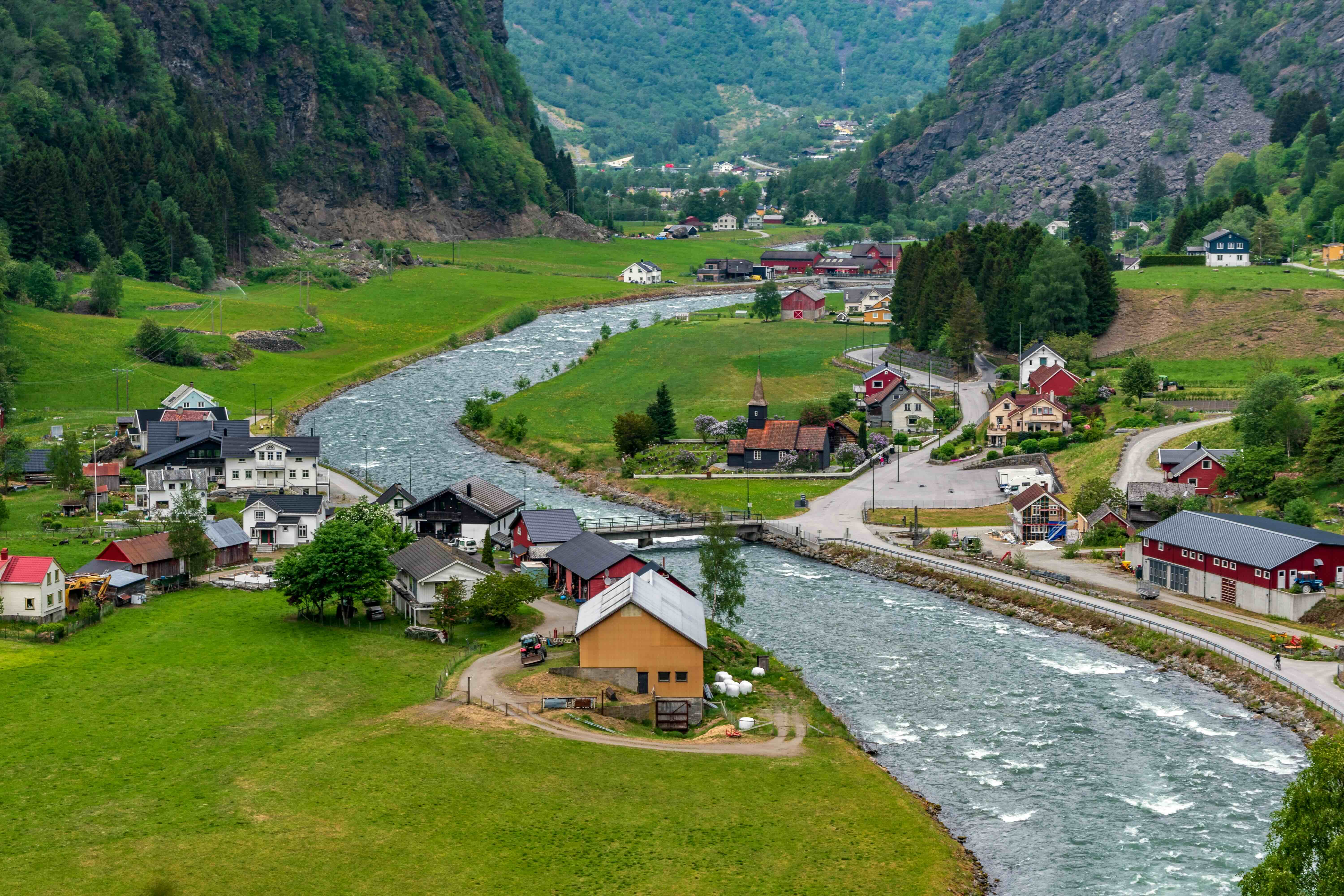
The final stretch from Voss to Bergen runs through the green, wet, steep-sided landscape of Vestland - past Dale, through long tunnels, along fjord arms and river gorges. The descent is a slow return to sea level and to the maritime west of Norway, where the rain that keeps everything so intensely green is more or less a fact of life. Then the train slides into Bergen Station and the crossing is over: from the Oslofjord to the North Sea coast in a single day.
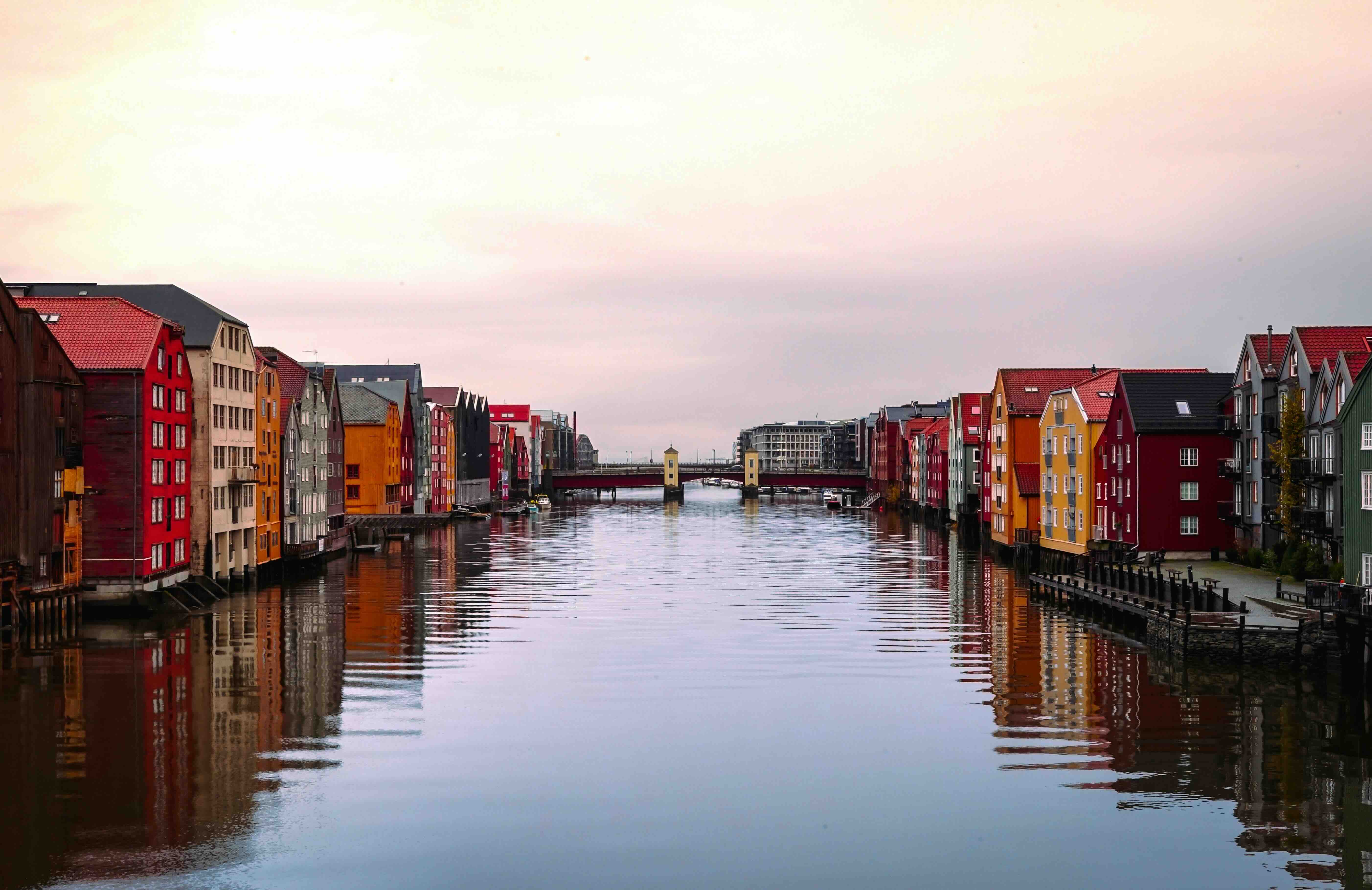
Bergen Station sits at the edge of the compact city centre. From here it is a short walk to Bryggen, the UNESCO-listed row of Hanseatic timber wharf houses that defined Bergen as a medieval trading capital; to the open-air fish market; and to the Fløibanen funicular, which climbs to the Fløyen viewpoint over the city and its seven surrounding mountains. Bergen calls itself the gateway to the fjords, and it means it - this is the launching point for boat trips to Sognefjord and Hardangerfjord and the wider western coast.
From Bergen Station
When to Go
June–August: long daylight, green valleys and full fjord services - the classic season, and the busiest. Reserve seats well ahead.
September–October & May: quieter and often more atmospheric - autumn colour or spring snowmelt, with the plateau still dramatic and trains easier to book.
Winter is spectacular but some connecting fjord and branch services run reduced - check what is operating before relying on a tight connection.
Onboard & Practical
- Long-distance trains carry a café/bistro area for hot drinks, snacks and simple meals - though many still bring their own provisions for a seven-hour crossing.
- The Bergen Line is genuinely family-friendly: no security or check-in, room to walk about, and family-friendly carriages with a play area on many services.
- Standard class is comfortable throughout; the upgrade is Vy's Komfort (Plus) class with extra legroom and a quieter carriage - there is no traditional "first class".
- No airline-style baggage limits: bring what you can carry, with overhead shelves and end-of-carriage racks for larger cases, skis and bikes.
- Dress in layers even in summer - Finse sits above 1,200 m and the plateau is cold and exposed while the valleys at each end can be mild.
The temptation is to treat Oslo–Bergen as a transfer and stay on to the end. Resist it, at least once: break the journey at Finse for a plateau walk, or at Myrdal for the Flåm Railway and the fjords. The Bergen Line is not the way to Bergen - it is the reason to go the long way round.
Hotels near Bergen Station
Arrive after seven hours across the mountains and you will not want to go far. All four properties below are within a short walk of Bergen Station and the old town, so you can step off the Bergensbanen and be checked in within minutes.
Bergen - directly beside the railway station
A historic hotel opened in 1928 immediately next to Bergen Station - arguably the most fitting arrival point on the whole line. Traditional rooms, a celebrated old whisky bar, and quite literally a two-minute walk from the platform.
Bergen - opposite the station
A contemporary design hotel directly across from Bergen Station, with a strong focus on local food and a relaxed, modern feel. The closest thing to stepping off the train and straight into a good breakfast.
Bergen - city park, few minutes from the station
A reliable, well-run hotel beside the city park (Byparken) and the light-rail line, a few minutes on foot from both the station and the harbour. A dependable, comfortable base for exploring the centre.
Bergen - harbourside, near Bryggen
On the harbour close to Bryggen and the fish market, a short walk from the station. Choose it if you would rather wake up beside the old wharf and the fjord boats than by the platforms.
Hotel links open Booking.com. Railero may earn a commission on bookings at no extra cost to you.
Frequently Asked Questions
- Is Oslo to Bergen one of Europe's most scenic train journeys?
- Widely, yes. The Bergen Line (Bergensbanen) is regularly named among the most beautiful rail journeys in Europe and the world. In a single day it climbs from the Oslofjord through forest and lakeland onto the Hardangervidda - the largest high-mountain plateau in northern Europe - crosses the treeless roof of the line near Finse at over 1,200 metres, then drops through waterfalls and fjord country into Bergen. The variety of landscape in one journey is what sets it apart.
- Do I need a seat reservation on the Bergen Line?
- A seat reservation is strongly recommended and, on this route, effectively expected - the Bergen Line is popular and busy trains do sell their reserved seats. Reservations are made when you book your ticket with the operator, Vy. In peak summer, booking ahead is the safest way to guarantee a seat, ideally a window one. Reservation practices and fares can change, so confirm the current details when you book.
- Can I use an Interrail pass on Oslo to Bergen?
- Yes. The Bergen Line is a normal Vy service, so Interrail pass holders can travel on it. A separate seat reservation is recommended on top of the pass, especially in summer, and any reservation fee is not covered by the pass itself. Note that the connecting Flåm Railway (Flåmsbana) from Myrdal is separately operated and is not fully covered by rail passes. Always check current pass conditions before you travel.
- Which side of the train has the best views from Oslo to Bergen?
- There is no single "wrong" side - the scenery switches from side to side across the journey, and the most dramatic stretch, the Hardangervidda plateau around Finse, is spectacular from both windows. If you want a general rule, many travellers favour the right-hand side heading Oslo to Bergen for the plateau and the descent toward the fjords, and the left-hand side on the return. On a quiet train it is worth moving between windows to catch each highlight.
- How long does the Oslo to Bergen train take?
- The full journey takes roughly seven hours to cover close to 500 kilometres across the mountains - this is a scenic mainline, not a high-speed dash, and the time is part of the point. Several departures run each day in both directions. Exact timings vary by service and season, so check current schedules with Vy when you plan your trip.
- Is there food on board the Bergen Line?
- Yes. Long-distance Bergen Line trains carry an onboard café/bistro area serving hot and cold drinks, snacks and simple meals, and there is at-seat power for devices. Catering ranges can change, and on a seven-hour mountain crossing many travellers still like to bring their own snacks and a water bottle as a backup.
- What is the best time of year to travel Oslo to Bergen?
- Every season looks completely different. Summer (roughly June to August) brings long daylight, green valleys and full connecting fjord services, but it is also the busiest - book ahead. Late spring and early autumn are quieter, with snowmelt waterfalls or autumn colour. Winter turns the Hardangervidda into a white Arctic-like expanse, which is extraordinary from a warm carriage, though some connecting services run reduced. There is no bad season - only different ones.
- Can I stop at Finse or Myrdal along the way?
- Yes, and many travellers do. Finse (1,222 m) is the highest station in northern Europe, roadless and reachable only by rail - a base for plateau walking in summer and cross-country skiing in winter. Myrdal is the junction with the Flåm Railway (Flåmsbana), the dramatic branch line down to the Aurlandsfjord and the classic "Norway in a Nutshell" fjord route. Break your journey by booking separate legs rather than a single through ticket. Services and connections can change, so confirm times before relying on a tight connection.
Continue Your Journey
Routes that pair naturally with this one — for building your European itinerary.
Interrail and the Swiss Travel Pass — when a pass beats point-to-point tickets and when it does not.
When reservation is mandatory, which side of the train has the views, and how to choose your class.
The Bergen Line is not the fastest way from Oslo to Bergen - it is the journey people cross Norway specifically to take. In a single unbroken day it climbs from a city on the fjord to the treeless roof of the Hardangervidda and down again to the North Sea coast, over a line that has been doing exactly this since 1909. Ride it slowly, take a window seat, and let the country change outside it.