Bern to Zermatt
The Matterhorn Gateway
This is one of the most practical rail journeys to reach the Matterhorn region: about 2 hours 10 minutes from the Swiss capital to car-free Zermatt, with a single easy change at Visp. The main line dives under the Alps through the Lötschberg Base Tunnel; the metre-gauge Matterhorn Gotthard Bahn does the rest, climbing the Matter Valley until the train rolls to a stop a few streets from the most famous mountain silhouette on earth.
Zermatt has no road access for visitors - cars stop down the valley at Täsch - so the railway is not one option among several; it is how the village is reached. Nearly everyone arriving by rail funnels through Visp, where the flat and the mountain networks meet, and the connection is engineered for it: timed transfers, a short signposted walk between platforms, and Zermatt trains every half hour through the day.
Why the train is the whole answer here: Drivers must park at Täsch and board a shuttle train for the final 12 minutes anyway - so from Bern, the through train with one relaxed change at Visp beats the car on time, cost and stress, and delivers you to the village centre.
Ready to book Bern to Zermatt?
These are ordinary Swiss scheduled trains: no reservations needed (or possible) on the regular services - buy a ticket and board, with connections running frequently all day. The Swiss Travel Pass covers the entire journey including the Matterhorn Gotthard Bahn, and Interrail passes are valid on both legs. Point-to-point tickets are sold as one through fare; Swiss saver day passes and supersaver fares can cut costs if your dates are fixed.
Railero may earn a small commission if you book via the link above, at no extra cost to you.
Leaving Bern - Out of the Capital, Toward the Wall of the Alps
Bern, Switzerland · 46.949°N, 7.439°E
Bern Hauptbahnhof sits at the edge of the UNESCO-listed old town, and the InterCity south leaves it with typical Swiss regularity - this is one of the country's main north–south corridors, so departures toward Visp and Brig run frequently all day. Board any Brig-bound InterCity; Visp is the second-to-last stop and the boards make the Zermatt connection explicit.
The first twenty minutes are a warm-up: the Aare valley, the Gürbetal's farmland, and then Lake Thun swinging into view on the left with the first serious peaks - Eiger, Mönch and Jungfrau on clear days - stacked behind it. It is worth a left-side seat from Bern for exactly this stretch.
Bern–Zermatt - Journey Facts
- RouteBern → Visp (main line) → Zermatt (Matterhorn Gotthard Bahn)
- Journey timeAbout 2h 10m including the change - check current schedules
- FrequencyFrequent through the day; Zermatt trains every half hour
- The changeOne, at Visp - timed, signposted, a few minutes on foot
- ReservationsNone needed on regular trains (Glacier Express excepted)
- PassesSwiss Travel Pass and Interrail valid throughout
Spiez and the Lötschberg - the Fifteen-Minute Alps
Spiez & the Lötschberg Base Tunnel · 46.686°N, 7.680°E
Spiez is the Bernese Oberland's gateway junction, arranged photogenically around its castle and vineyard bay on Lake Thun - glance right as the train calls. From here the line turns away from the lake and climbs gently to Frutigen, where the modern route disappears into the Lötschberg Base Tunnel: 34 kilometres under the Bernese Alps, crossed in roughly fifteen minutes of smooth darkness.
The tunnel is the reason this journey is so short. Before it opened in 2007, trains wound over the old Lötschberg mountain line high above the Kander valley - a beautiful detour that regional trains still make. You emerge abruptly into a different Switzerland: the dry, sunlit Rhône valley of the Valais, with vineyards on the slopes and ten of the Alps' highest peaks hidden behind the valley walls.
North of the Lötschberg it is lakes and green hills; fifteen minutes of tunnel later it is the stone and sun of the Valais. Few trains change worlds so fast.
Changing at Visp - Where the Mountain Railway Takes Over
Visp, Valais · 46.293°N, 7.880°E
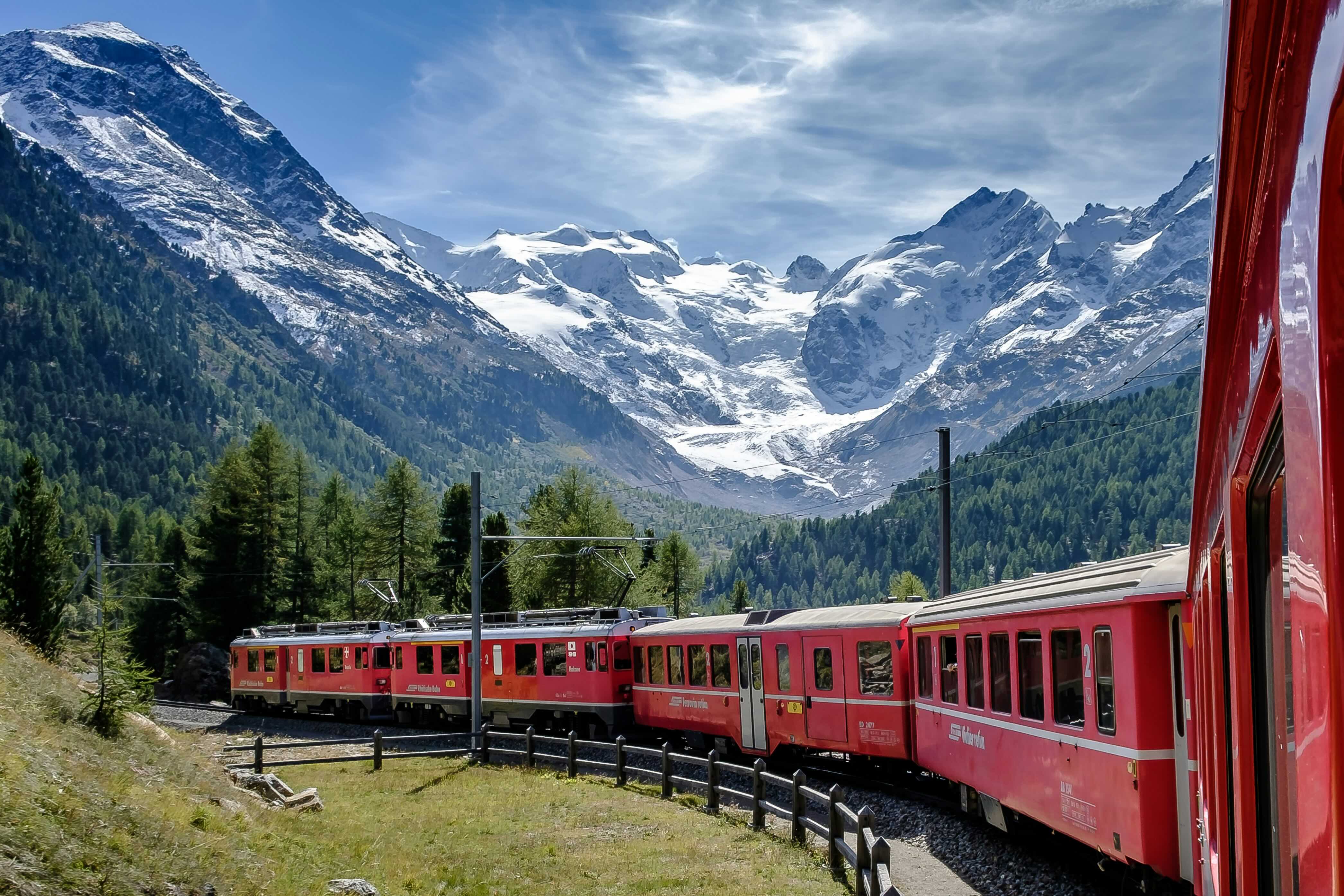
Visp is where nearly every Zermatt journey pivots, and the station is built for the job: the main-line platforms and the Matterhorn Gotthard Bahn's own tracks are a short, signposted walk apart, connections are timed against the InterCity arrivals, and the red MGB trains are unmistakable. A few unhurried minutes cover the transfer - no stairs-sprinting required if your inbound train is on time.
The change is also a change of railway logic. The MGB is metre-gauge and rack-assisted, engineered for gradients the main line could never touch. From Visp it runs briefly along the Rhône to Stalden, then commits to the Matter Valley proper - and the character of the trip shifts from intercity cruise to mountain climb.
Worth Knowing
Into the Matter Valley - an Hour of Honest Mountain Railway
St. Niklaus, Randa & Täsch · climbing toward 1,600 m
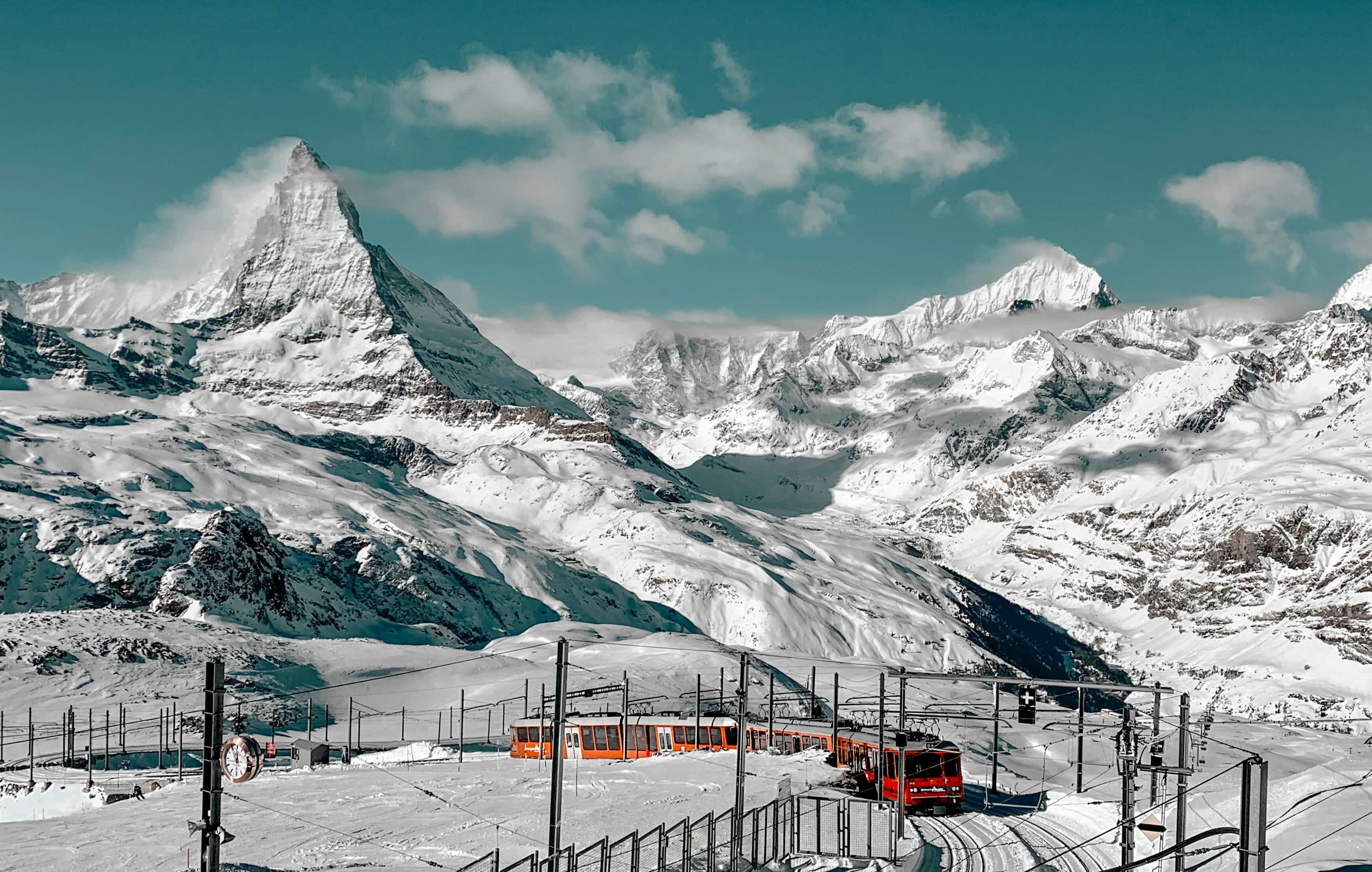
The final hour is the scenic heart of the journey. The narrow-gauge line threads a valley that tightens as it climbs, crossing the young Vispa river and leaning on its rack sections where the gradient demands: past St. Niklaus with its slender church spire, then Randa, where the scars of the huge 1991 rockfalls still streak the mountainside above the line.
At Täsch the road gives up - this is where drivers park and join the shuttle trains for the last 12 minutes - and the valley delivers its ending. Watch ahead on the right as the train curves toward Zermatt: the Matterhorn has a habit of appearing suddenly, filling the head of the valley exactly as advertised.
The main line got you to the mountains; the Matter Valley hour is the mountains - rack rails, rockfall scars and the Matterhorn waiting at the end.
Zermatt - Arrival in the Car-Free Village
Zermatt, Valais · 46.021°N, 7.749°E · ~1,600 m
The train stops at Bahnhofplatz, and that is the commute done: Zermatt is car-free, so the station square - busy with electric hotel shuttles, hand carts and walkers - is the village centre for practical purposes. Most hotels are within a ten-to-fifteen-minute walk, and the main street begins directly opposite the station.
Zermatt's railway station is really a junction of adventures. Directly across the square, the Gornergrat Bahn - Europe's highest open-air rack railway - climbs to its 3,089 m viewpoint facing the Matterhorn. And from the very platforms you arrived at, the Glacier Express begins its famous eight-hour crossing to St. Moritz. Arriving from Bern, you are one square away from both.
From Zermatt Station
Rail Passes, Tickets and the Reservation Question
How ticketing works on Switzerland's turn-up-and-go network
This journey runs on Switzerland's turn-up-and-go system: regular trains carry no reservations at all, a single through ticket covers both the main line and the Matterhorn Gotthard Bahn, and missing a connection simply means taking the next one on the same ticket. The Swiss Travel Pass covers the entire route - including the MGB leg, which surprises travellers who expect mountain railways to be extras - and Interrail passes are valid on both trains too.
The genuine extras start after arrival: the Gornergrat Bahn and Zermatt's lift network are excursion fares, typically discounted (not free) with the major passes - check current conditions. And one planning note pays for itself: if the Glacier Express is your next move, its compulsory seat reservations sell out weeks ahead in summer, so book that leg when you book Zermatt, not on the platform.
Quick Rules
Regular trains: no reservations, frequent departures, one through ticket or any major rail pass.
Swiss Travel Pass: covers Bern → Zermatt fully, MGB included; mountain excursions are discounted extras.
Luggage: no practical limits on board, and SBB's checked-luggage service can send bags ahead to Zermatt.
Not the Glacier Express - but the Way to It
Zermatt as the western terminus of the famous crossing
A common mix-up, worth clearing up: Bern to Zermatt is not the Glacier Express. The famous panoramic train does not serve Bern at all - it runs east from Zermatt to St. Moritz, taking around eight deliberately slow hours over the Oberalp Pass. What this route is, is the practical western approach: the everyday trains that put you in Zermatt, where the Glacier Express begins.
That is exactly why so many itineraries combine the two. Arrive from Bern in the afternoon, spend a day or two under the Matterhorn - Gornergrat at sunrise is the classic - then board the Glacier Express east across the whole grain of the Swiss Alps. One arrival route, one great crossing, no backtracking; it is the strongest two-train combination in Switzerland.
Think of it as the approach march: Bern gets you to base camp in two hours; the Glacier Express is the expedition.
Hotels in Zermatt
Everything in car-free Zermatt is walkable from the station - the practical choice is anywhere along or near the Bahnhofstrasse, with electric hotel shuttles meeting trains for luggage-heavy arrivals.
Zermatt - Bahnhofstrasse, village centre
The village's grande dame since 1879, five minutes' walk from the station with its own horse-drawn and electric shuttles - alpine luxury with Matterhorn views from the upper floors.
Zermatt - steps from the station
A dependable modern mid-range hotel on the main street moments from Bahnhofplatz - the easy pick for rail travellers with early Glacier Express departures.
Zermatt - opposite the station
A budget classic literally facing the platforms, long beloved of hikers and ski tourers - simple rooms, shared kitchen, unbeatable position for the price.
Hotel links open Booking.com. Railero may earn a commission on bookings at no extra cost to you.
Frequently Asked Questions
- How long does the train from Bern to Zermatt take?
- Around 2 hours 10 minutes in total: roughly an hour from Bern to Visp on the main line through the Lötschberg Base Tunnel, then about an hour up the Matter Valley on the Matterhorn Gotthard Bahn. Connections run frequently through the day - check current schedules for exact times.
- Do I have to change trains on the way to Zermatt?
- Yes, once, at Visp - every itinerary to Zermatt does, because the final leg is a separate metre-gauge mountain railway. The change is easy: connections are timed, the Zermatt trains leave from their own platform a short walk from where you arrive, and the interchange is signposted. Zermatt trains run every half hour for most of the day.
- Is the Bern to Zermatt train covered by rail passes?
- Yes - the Swiss Travel Pass covers the whole journey including the Matterhorn Gotthard Bahn, and Interrail passes are also valid on both legs. Mountain excursions from Zermatt itself (like the Gornergrat railway) are separate, though passes typically earn a discount - check current conditions.
- Do I need a seat reservation for Bern to Zermatt?
- No - these are ordinary Swiss scheduled trains: sit anywhere, no reservation needed or even possible on the regular services. The exception is the Glacier Express panoramic train from Zermatt onwards, which is reservation-only.
- How does luggage work, and can I send it ahead?
- There are no practical luggage limits on board - racks are generous on both trains. Switzerland also offers a station-to-station checked-luggage service, so you can send bags ahead to Zermatt and travel light; check SBB’s current luggage services for details and timings.
- Is this the Glacier Express?
- No - Bern to Zermatt is the everyday gateway route, not the famous panoramic train. The Glacier Express starts in Zermatt and runs east to St. Moritz over the Oberalp Pass. Many travellers combine the two: arrive in Zermatt via this route, then board the Glacier Express for the great east-west crossing.
Continue Your Journey
Routes that pair naturally with this one — for building your European itinerary.
Interrail and the Swiss Travel Pass — when a pass beats point-to-point tickets and when it does not.
When reservation is mandatory, which side of the train has the views, and how to choose your class.
Bern to Zermatt is the gateway done right: a capital-city departure, fifteen minutes under the Alps, one unhurried change at Visp, and an hour of genuine mountain railway ending in a village where the train is the only way in. Use the Swiss Travel Pass if you are touring, send your bags ahead if you are travelling heavy, and keep a day in hand for the Glacier Express - Zermatt is where it begins.